
Why High-Conflict Divorce Costs More
Most people expect a divorce to cost money. What surprises them is the gap between one divorce and another. Two couples can file in the same month, in the same court, with similar homes and similar incomes. One finishes in months. The other is still going two years later. Why high-conflict divorce costs more is the question hiding inside that gap.
The answer is not that the lawyers charge a different rate. Why high-conflict divorce costs more comes down to something simpler. Conflict creates work, and almost everyone who handles that work is paid by the hour.
The short answer, in one number
A put it more sharply than most articles will.
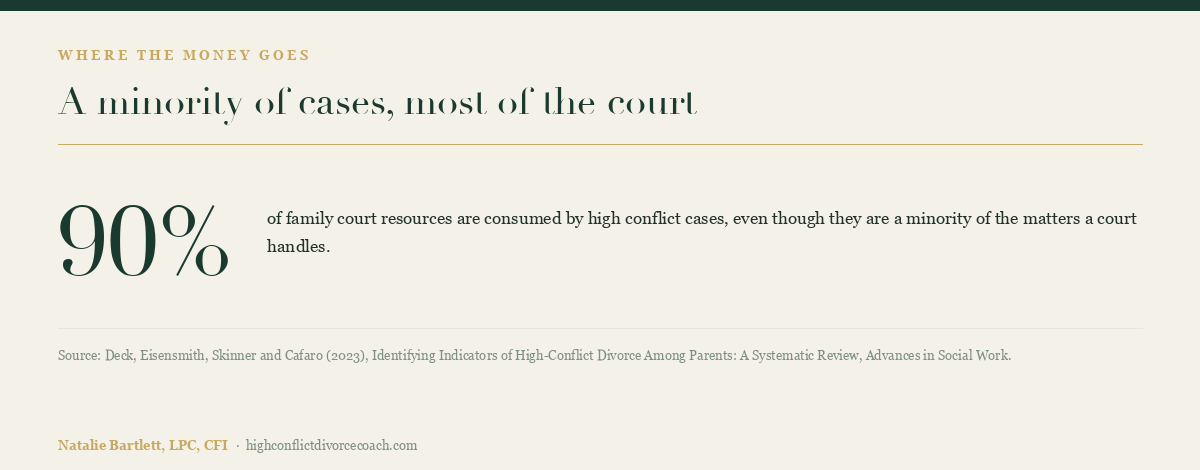
High conflict cases are a minority of family court matters. They consume around 90 percent of family court resources.
That single line explains the whole thing. A small group of cases absorbs almost all of the time, the hearings, the expert appointments and the judicial attention. If your case is in that group, you are not paying a slightly higher version of a normal bill. You are inside the part of the system where nearly all the work happens.
How many divorces are actually high conflict?
Fewer than people assume.
The same 2023 review found that roughly one quarter to one third of divorces in the United States involve high levels of conflict. That range comes from Maccoby and Mnookin's Californian study of 1,124 families in 1992 and from more recent work by Visser and colleagues in 2017. A Dutch study put the figure at close to 20 percent. Different countries, different decades, similar answer.
It is worth knowing how those cases spread out once they reach a court. Janet Johnston set this out in The Future of Children, reviewing the Maccoby and Mnookin data. The researchers called it a conflict pyramid.
| Where the case went | Share of divorces |
|---|---|
| Custody and visitation never contested | About half |
| Contested, but settled without the court | Nearly a third more |
| Settled through court mediation | 11% |
| Settled after a formal custody evaluation | 5% |
| Settled during trial | 2% |
| Decided by a judge | 1.5% |
Read the bottom rows again. Fewer than one divorce in ten reaches an evaluation, a trial or a judge's decision. That thin slice is where the money goes, and it is the same slice consuming most of the court's resources.
You are not being quoted a price for "a divorce". You are somewhere on that pyramid, and where you sit matters more than your lawyer's hourly rate.
What each step up the ladder adds
Every rung of that pyramid adds a different kind of work, not just more hours of the same work.
| Step | What gets added |
|---|---|
| Uncontested | Filing and paperwork |
| Contested, settled privately | Negotiation between two lawyers |
| Court mediation | A mediator, plus preparation for the session |
| Custody evaluation or investigator | A third professional, interviews, records, a written report |
| Trial | Exhibits, witness preparation, court days |
| Judge decides | Everything above, and a result neither side controls |
The jump that surprises people most is the fourth one. Up to that point you are paying lawyers. At that point a new professional enters the case with their own fee, their own timeline, and their own process.
What a Colorado investigator appointment actually costs
Colorado is unusually clear about this, which helps if you live here.
Under section 14-10-116.5 of the Colorado Revised Statutes, a court can appoint a , usually shortened to CFI. The CFI investigates and reports back to the court on what arrangement serves the children. The role is defined as a brief, nonintrusive and cost-effective assessment. It is deliberately narrower than a full parental responsibilities evaluation.
The Colorado Supreme Court also caps what a privately paid CFI may charge. Under , amended effective 7 August 2024, the presumptive maximum fee for the investigation and report is $3,250 per appointment. Going above that needs prior court approval, in a written order with specific findings about the extraordinary circumstances that justify it. Even if both parties agree to pay more, a judge still has to approve it in writing.
Two things that cap does not cover are worth knowing before you plan around it.
Testimony and preparation time are handled separately. If the CFI is called to testify, that is additional.
Discovery costs specific to your case sit outside the cap and are allocated between the parties by the appointment order.
So the appointment has a known ceiling, and the litigation around it does not. That is the honest shape of it.
I have served in this role. The part parents rarely expect is how much of the eventual cost is set long before anyone is appointed. By then the record already exists.
Five signs a case is heading up the pyramid
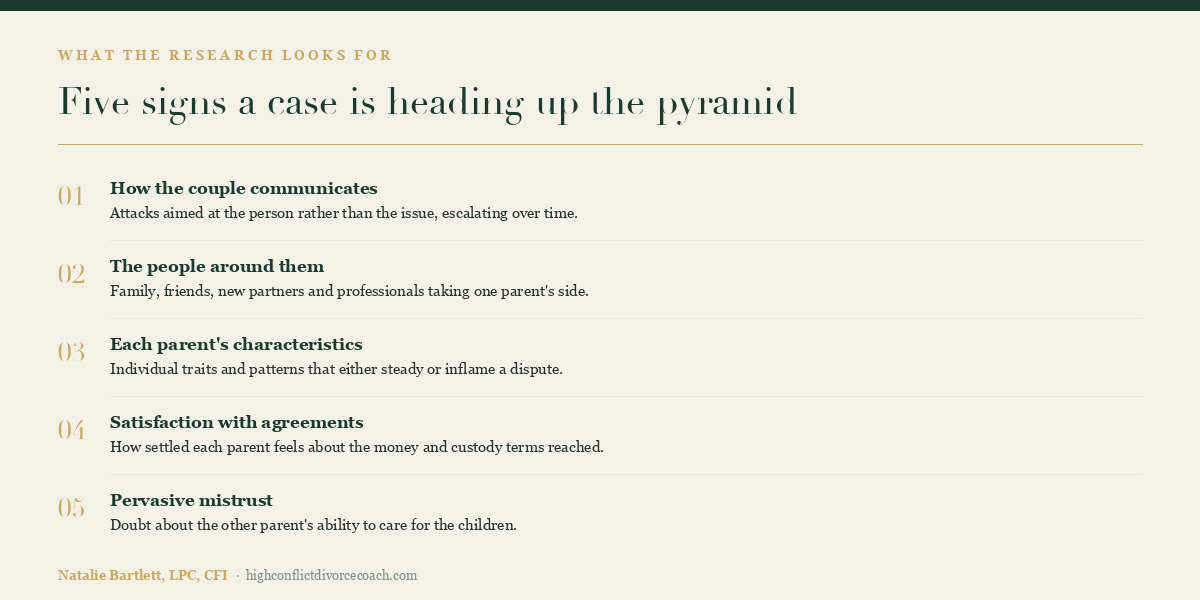
The 2023 systematic review looked at eleven peer-reviewed studies and found no single agreed definition of high conflict. What it did find were five themes that showed up consistently.
How the couple communicates. High conflict couples exchange attacks aimed at the person rather than the issue, and those exchanges escalate over time.
The people around them. Family, friends, new partners and even professionals can act as a cheer squad for one side. Perceived disapproval of a former spouse from someone's network is linked to more co-parenting conflict.
Individual characteristics of each parent.
Satisfaction with the agreements reached over money and custody.
Pervasive mistrust, particularly doubt about the other parent's ability to care for the children.
None of these is a diagnosis, and none of them decides anything on its own. They are useful because they are observable. If you recognise several, that is information about where your case may be heading, and about what it may be worth addressing early.
Why nothing stays settled
This is the part people do not expect, and the research is clear about it.
Parents in the high conflict group were tracked over three years. Conflicted parents rarely became cooperative. Most stayed conflicted. A small number simply disengaged from each other.
That changes how you should think about cost. You may not be paying to decide something once. You may be paying to decide it again.
What the conflict does to children
This is the cost that never appears on an invoice, and the one most parents care about most.
Johnston's review found a clear pattern. Children of high conflict divorce, boys especially, were two to four times more likely to show clinically significant emotional and behavioural problems than national norms.
There is a second finding that surprises people, and it matters for planning.
Court-ordered joint physical custody and frequent visitation in high conflict cases were associated with worse outcomes for children, not better, with the effect strongest for girls. More contact did not help while conflict stayed high.
Read that carefully, because it is easy to misuse. It is a pattern across many families, not a verdict on yours. What is right in your case is for your court and your lawyer to decide. But it is why reducing the number of exchanges often works better than increasing them. Your is a financial decision as well as a parenting one. Every handoff is a chance for a new dispute.
How long does a high conflict divorce take?
Longer than a cooperative one. Anyone offering you a precise number does not know your court.
Duration depends on your state, your judge's calendar and what is disputed. Custody disputes run longer than property disputes. A case with a formal evaluation runs longer than one without.
What matters more than the number is what it means. Time is what turns a difficult divorce into an expensive one. Anything that shortens the case saves money. Anything that extends it costs money, including the arguments that feel satisfying at the time.
What actually brings the cost down
You cannot control the other person. That is worth saying plainly, because a lot of advice quietly assumes you can.
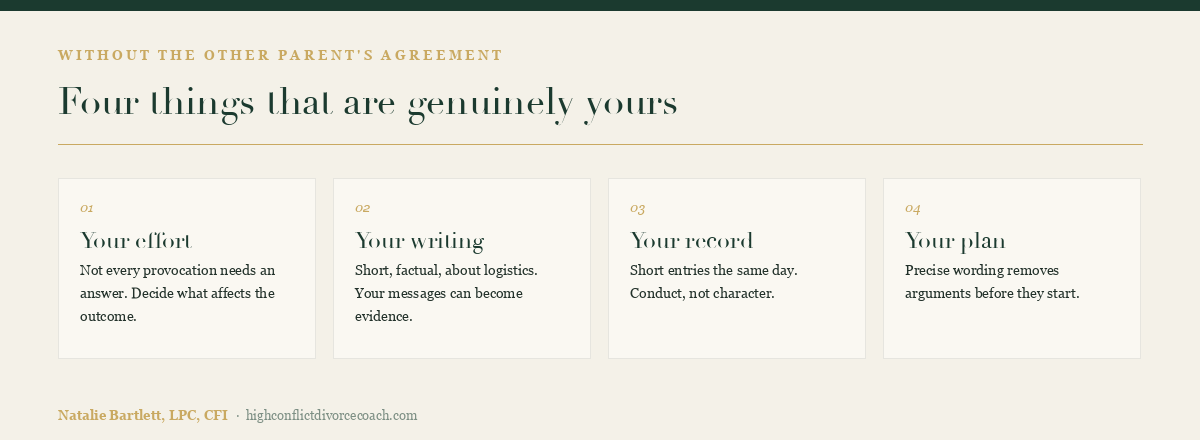
Four things are genuinely yours.
Where you spend your effort. Not every provocation needs an answer. Decide what affects the outcome, and let the rest go unanswered.
How you write. Keep messages short, factual and about logistics. Do not defend yourself in writing. In a contested case your messages can become evidence.
What you document. Short entries written the same day, recording conduct rather than character. That is worth more than a thousand screenshots.
How precise the plan is. Vague wording is where the next three years of conflict will live. A that leaves nothing open to interpretation removes arguments before they start.
Given what the research says about conflicted parents rarely becoming cooperative, strategies that depend on the other person changing are the expensive ones. Strategies that work without their cooperation are the ones that hold.
Where a coach fits, and where one does not
A divorce coach does not replace your attorney. Only an attorney can advise you on the law.
The work sits in a different place. It is the preparation, the communication, the documentation and the decisions taken between the legal steps. Those decisions get made quickly, under pressure and usually alone. They are also where a great deal of the cost is created.
If you want the fuller picture, it is set out in . If the difficulty is mainly communication around co-parenting, is built for co-parenting that has to work without cooperation from the other side. If you are still working out whether your situation meets the threshold, start with what actually means.
Frequently asked questions
-
There is no single figure, and any article giving you one is guessing. What decides it is where your case lands on the pyramid, how long it runs, whether an investigator is appointed, and how often settled issues reopen. Your attorney can give you a realistic range once they know your specifics.
-
The court's appointment order sets how the fee is allocated between the parties, and it is not always split evenly. The fee is paid as a retainer, with the CFI billing against it as work is done. Anything left over when the appointment ends must be returned to the parties.
-
Not always. Mediation saves a great deal when both people are willing to settle. When one person treats it as another place to argue, it becomes one more paid session ending without agreement. In the Californian data, court mediation resolved many cases but not the most entrenched ones.
-
Yes. Coaching is not legal representation and does not replace it. A coach works on preparation, communication and strategy between the legal steps. Legal advice must come from your attorney, and the two roles work best when kept separate.
Sources
Deck, P., Eisensmith, S., Skinner, B., and Cafaro, J. (2023). . Advances in Social Work, Vol. 23, No. 2, pp. 392 to 408. DOI: 10.18060/25294.
Johnston, J.R. (1994). . The Future of Children, Vol. 4, No. 1, pp. 165 to 182. Reviewing Maccoby, E.E. and Mnookin, R.H. (1992), Dividing the Child: Social and Legal Dilemmas of Custody, a study of 1,124 Californian families and 1,875 children.
Colorado Revised Statutes, section 14-10-116.5, Child and Family Investigators.
Colorado Supreme Court, , amended effective 7 August 2024.
A note on the data. The conflict pyramid comes from a study published in 1992, and no larger study has replaced it. The 2023 systematic review reports a similar prevalence range, which is why it is still cited. Court procedures differ by state and have changed since. Treat the pyramid as a picture of how conflict concentrates, not as current statistics for your county. Fee figures are current as at the 2024 amendment and should be checked against the directive in force when you read this.
About the author
Natalie Bartlett, LPC, CFI is a Licensed Professional Counselor (#3250) and court-appointed Child and Family Investigator based in the Denver metro area, serving courts across Colorado. Over twenty-six years she has served as a CFI, testified as an expert witness, worked as a mediator, supervised parenting time, and coached clients through high conflict divorce and custody matters.
DisclaimerThe information provided in this article is for general educational and informational purposes only. It does not constitute, and should not be relied upon as, legal advice, therapeutic or mental health advice, medical advice, or professional counseling of any kind.
High Conflict Divorce Coach provides strategic divorce and co-parenting coaching. It does not provide legal services, psychotherapy, counseling, diagnosis, or treatment. While Natalie Bartlett holds a license as a Licensed Professional Counselor, she does not provide therapy, counseling, or clinical services through High Conflict Divorce Coach, and no therapeutic or counseling relationship is created by reading this content or by engaging High Conflict Divorce Coach for coaching services.
Reading this article does not create a coaching, counseling, or professional relationship of any kind. Every situation is different. Nothing here should be acted upon without consulting a qualified attorney, licensed mental health professional, or other appropriate professional regarding your specific circumstances.
If you are experiencing a mental health crisis or emergency, contact a licensed professional or emergency services immediately.