
Custody Schedules: 50/50, 60/40 and High-Conflict Tips
A custody schedule sets out when a child is with each parent. The most common are 50/50 (equal time), 60/40, and 70/30, and each of those can be arranged in several patterns: week-on/week-off, 2-2-5-5, 3-4-4-3, and others. The right one depends on your child's age, the distance between homes, and your court. But in a high-conflict case there is one more factor that matters more than the split itself, which is how many exchanges the schedule creates and how precisely it is written. This guide explains the common schedules, then what changes when conflict is high.
What is a custody schedule?
A custody schedule is the parenting-time part of a parenting plan, meaning the calendar of who has the children when. It is separate from legal custody, which covers who makes major decisions about school, medical care, and religion, and which can be shared even when the day-to-day time is not equal.
Two terms you will see: joint (or shared) physical custody, where the child spends substantial time with both parents, and primary or sole physical custody, where one parent has most of the overnights and the other has scheduled time. The percentages below describe roughly how the overnights divide.
The most common 50/50 custody schedules
50/50 means equal parenting time. The same split can be arranged in very different rhythms.
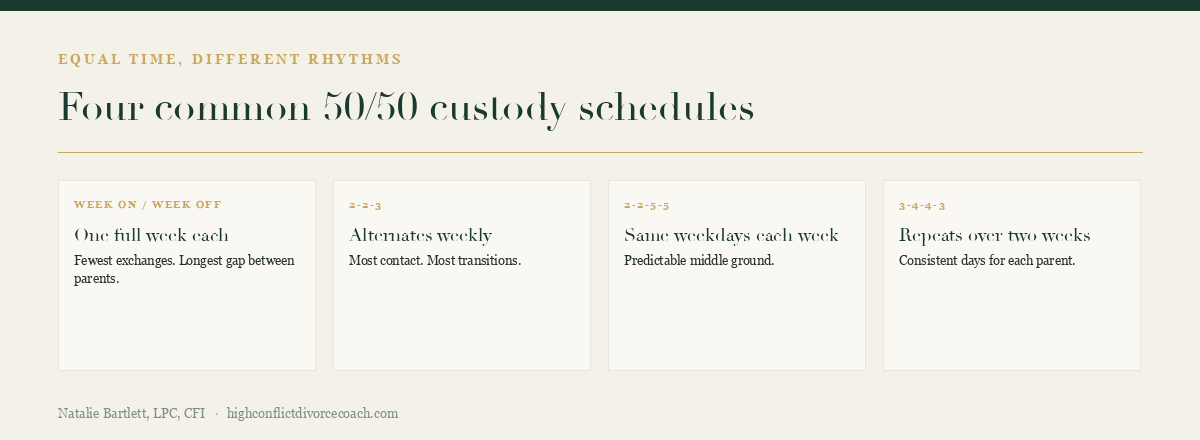
Week-on / week-off
The child spends one full week with each parent. This has the fewest exchanges, one a week, which is often why high-conflict families prefer it. The trade-off is a long gap between seeing each parent, which can be hard for younger children.
2-2-3
Two days with Parent A, two with Parent B, then three with A, and it flips the next week. Children see both parents often, but it creates many exchanges, which means many opportunities for conflict.
2-2-5-5 (and 5-2-2-5)
Two days with A, two with B, then five with A and five with B. Each parent always has the same weekdays, which makes it predictable and easier to plan around. It is a popular middle ground: more contact than week-on/week-off, fewer transitions than 2-2-3.
3-4-4-3
Three days with A, four with B, then four with A and three with B, repeating over two weeks. Like 2-2-5-5, each parent keeps consistent days.
[IMAGE 1 OF 3 — insert here] File: 50-50-custody-schedule-patterns.png Alt text: Four common 50/50 custody schedule patterns Position: after the 3-4-4-3 sub-section, before the "60/40 and 70/30" heading.
60/40 and 70/30 custody schedules
Not every family shares time equally. These arrangements give one parent more overnights, often because of work, distance, or the child's needs.
60/40 schedules
Around four nights with one parent and three with the other each week, commonly a 4-3 split, or alternating extended weekends plus a midweek overnight. It keeps both parents closely involved while giving one home a little more stability.
70/30 schedules
One parent has the child roughly five nights a week and the other about two, often every other weekend extended from Thursday to Monday plus a midweek visit, or every weekend plus an evening. It is common when one parent lives farther away or the child is settled in one home.
Exact percentages vary by how weekends and holidays are counted, so treat these as patterns rather than formulas. What a court orders depends on your state's law and your child's best interests, which is a question for your attorney rather than an article.
Which schedule works best in a high-conflict case?
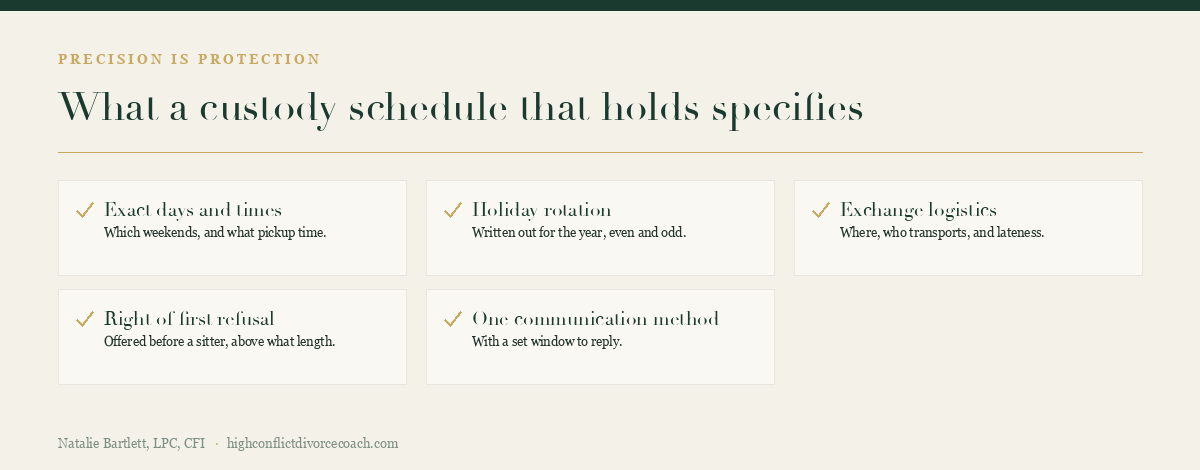
Here is the part most schedule guides miss. In a high-conflict divorce, the pattern often matters more than the percentage, because every exchange is a potential flashpoint.
A schedule with frequent handoffs, such as 2-2-3, creates constant contact and constant opportunities for an argument, a late pickup, or a dispute about a swap that was refused. Longer blocks, such as week-on/week-off or 2-2-5-5, reduce the number of transitions, and with them the number of conflict points.
There is also a research finding worth knowing. Reviews of high-conflict divorce have found that where conflict stays high, frequent back-and-forth and enforced cooperation were linked to worse outcomes for children rather than better ones. More contact did not mean better. I share that carefully, because it is a pattern across many families rather than a verdict on yours, and what is right in your case is for your court and your lawyer to decide. But it is why, in high-conflict situations, minimising transitions and using parallel parenting, where each home runs independently with little direct contact, is often the more workable path.
[IMAGE 2 OF 3 — insert here] File: exchanges-and-conflict-points.png Alt text: Fewer exchanges means fewer conflict points Position: at the end of "Which schedule works best in a high-conflict case?", before the next heading.
How to write a custody schedule that holds
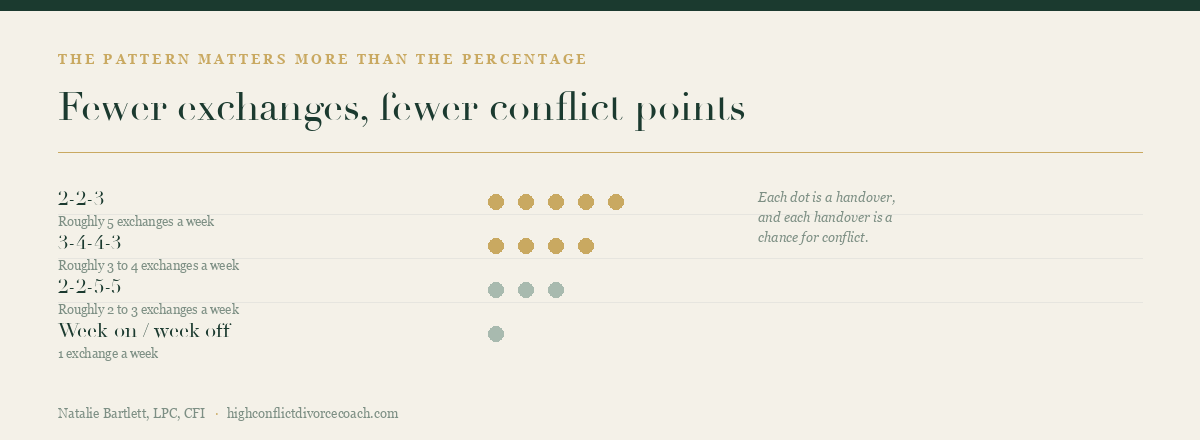
In a high-conflict case, a vague schedule is an invitation to fight. Precision is protection, and the schedule is one part of a broader . A schedule that holds usually specifies:
Exact days and times for the regular rotation, not "alternating weekends" but which weekends and what pickup time.
A holiday and school-break rotation written out for the year, including who has which holiday in even and odd years.
Exchange logistics. Where handoffs happen, since a neutral location can reduce conflict, who transports, and what happens when someone is late.
Right of first refusal. Whether the other parent is offered the time before a babysitter is used, and above what length of absence.
One documented communication method with a set window to reply, so scheduling does not become a daily argument.
The goal is not to win every clause. It is to leave nothing to interpretation, because ambiguity is exactly where high-conflict schedules break down.
If the difficulty is less about the calendar and more about the communication around it, is a nine-session framework built for co-parenting that has to function without cooperation from the other party. If you are still working out whether what you are dealing with meets the threshold, it is worth reading what actually means first.
Frequently asked questions
-
There is no single national standard, but week-on/week-off and 2-2-5-5 are among the most common 50/50 arrangements, and an extended alternating weekend pattern is common where one parent has the majority of time. The best fit depends on the child's age, the distance between homes, and your court.
-
Not automatically. Equal time works well for many families, but research on high-conflict cases suggests that when conflict stays high, frequent transitions can be harder on children, so the structure matters as much as the split. This is a decision for your court, guided by your child's specific needs.
-
Split custody usually refers to siblings being divided between parents, where each parent has primary custody of different children. It is uncommon and generally used only when there is a specific reason, because courts often prefer to keep siblings together. It is different from shared 50/50 custody, where the same child spends substantial time with both parents.
-
Usually yes, but the process varies by state and typically requires either both parents' agreement or a showing that circumstances have changed. Document how the current schedule is working, or not working, and speak with your attorney before requesting a modification.