
High-Conflict Parenting: Plans, Signs and What Helps
High-conflict parenting is what happens when raising children together stays hostile long after the relationship ends. A high-conflict parent is not simply a difficult ex. It is an ongoing pattern of aggression, hostility, and distrust that turns ordinary decisions, like a pickup time or a doctor's appointment, into another fight. If you are living it, the label matters less than the pattern, and the pattern is what you can plan around. This page explains what high-conflict parenting is, what a parenting plan needs to survive it, and whether a class or coaching is the right kind of help.
What makes a parent "high conflict"?
You usually cannot tell from one bad week. You can tell from the pattern that keeps repeating after separation.
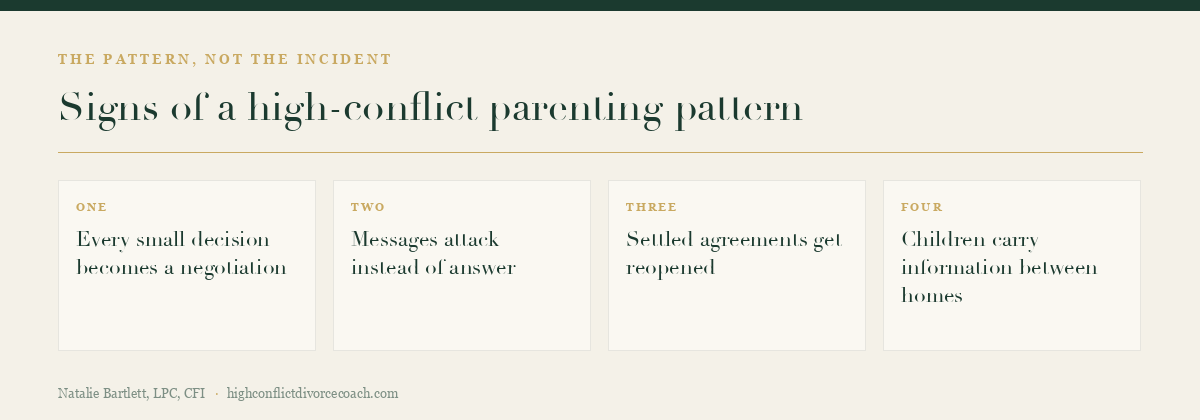
Researchers who study these families look for the same signs: aggression, open hostility, and deep distrust between parents. Day to day, that tends to look like every small decision becoming a negotiation, messages that attack instead of answer, agreements that get reopened, and children being used to carry information between two homes.
An important caution: describing a pattern is not diagnosing a person. Terms like "narcissist" get used loosely online, and only a qualified professional who has evaluated someone can make a clinical diagnosis. For your own purposes, focus on observable behaviour rather than labels. It is more accurate, and it holds up far better if the matter is ever in front of a court.
High-conflict parenting vs high-conflict co-parenting
The two phrases point at slightly different things. High-conflict parenting describes the overall situation: two parents, ongoing hostility, children in the middle. High-conflict co-parenting describes the working relationship, meaning how badly the two of you coordinate day to day.
Most people arrive here because the co-parenting piece has broken down and even basic logistics have become adversarial. That points to the fix. When cooperation is not available, the answer is not better cooperation. It is a structure strong enough to function without it.
What a high-conflict parenting plan needs
A normal parenting plan assumes two reasonable adults who fill in the gaps in good faith. A high-conflict parenting plan assumes the opposite, and removes the gaps. The most common mistake is vague language. Phrases like "reasonable notice" and "as agreed between the parents" are where the next three years of conflict will live. Precision is protection.
A high-conflict parenting plan checklist
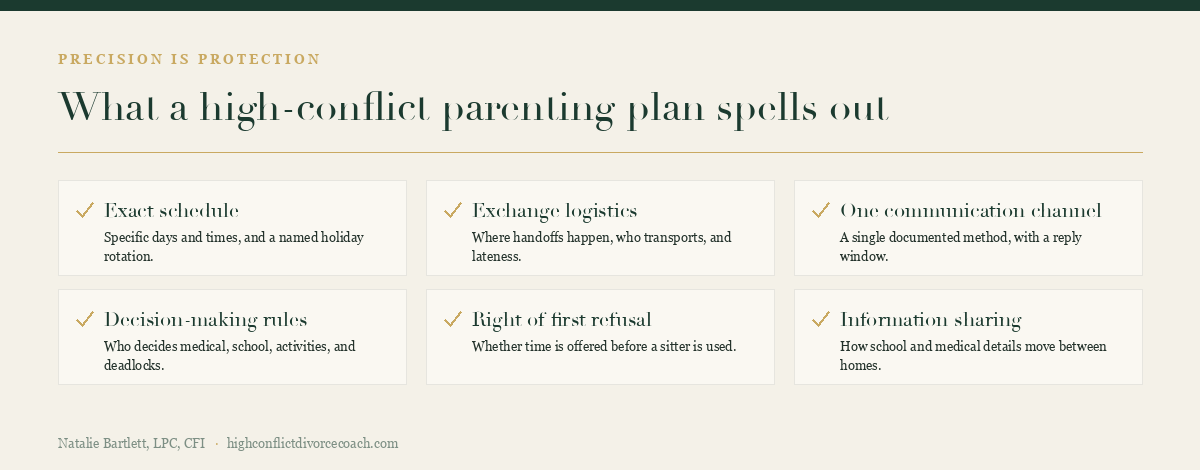
A plan built for high conflict usually spells out:
An exact schedule. Specific days, times, and a named holiday and school-break rotation, not "as agreed."
Exchange logistics. Where handoffs happen, who transports, and what happens when someone is late.
One communication channel. A single documented method, ideally an app that keeps a record, and a set window to reply in.
Decision-making rules. Who decides medical, school, and activities, and how a deadlock is broken.
Right of first refusal. Whether the other parent is offered time before a sitter is used, and above what length.
Information sharing. How school and medical details move, so neither parent is a gatekeeper.
The goal is not to win every clause. It is to leave nothing open to interpretation, because ambiguity is where high-conflict cases reignite.
Do you need a class or coaching?
Searching this topic, you will see two very different things offered, a class and coaching, and they solve different problems.
A high-conflict parenting class, sometimes court-ordered and sometimes called a co-parenting or parenting after separation course, is standardized education. If a court has required one, complete the specific program your court approves rather than a general article or a coach, because only the approved provider satisfies the order.
Coaching is personalized and strategic. It does not replace a required class. It helps you apply the ideas to your actual situation: building the plan above, handling a specific hostile pattern, and staying calm and court-ready while you do. If your problem is that you have done the class and still do not know how to handle this, that is the gap coaching fills. In short, if a court ordered a class, take the class. If you need a plan and support for your case, that is co-parenting coaching.
How to parent alongside a high-conflict co-parent
While the plan does the structural work, a few habits protect you and your children day to day.
Keep messages short, factual, and about logistics. Answer the question and leave the rest. Do not defend yourself in writing.
Treat communication as a record. Your messages can become evidence. Before sending, ask whether you would be comfortable with a judge reading it aloud.
Keep a simple log. Dates, missed exchanges, and things said in front of the children, in short entries written the same day. That beats a thousand screenshots.
Consider parallel parenting. When cooperation is not possible, it lets each parent run their own household with minimal contact, using the plan and an app instead of negotiation.
One more, and it is backed by the research: the wellbeing of the parent doing most of the caring matters as much as the conflict itself. Looking after yourself is protection for your children.
If you are still working out whether what you are dealing with meets the threshold, it is worth reading what high conflict divorce actually means first.
Frequently asked questions
-
A parent locked in an ongoing pattern of hostility, disputes, and distrust with the other parent after separation, where the conflict rather than any single event is the defining feature. It describes behaviour over time, not a clinical diagnosis.
-
No. A class is standardized education a court may require, and it must be the provider your court approves. Coaching is personalized strategy for your situation and does not satisfy a court-ordered class requirement. Many parents do both.
-
Often the realistic goal isn't cooperative co-parenting but parallel parenting, a structure that lets both households function with minimal direct contact. It works because it doesn't depend on the other person changing.
-
Highly specific. It replaces vague language with exact schedules, defined exchange logistics, one documented communication channel with response times, clear decision-making rules, and information-sharing terms, so that it works even when the two parents do not agree.