
The Stages of Divorcing a Narcissist
Most people come to this subject having read two kinds of article, and finding neither sufficient. Law firms describe the procedure: filing, disclosure, discovery deadlines, the mechanics of a case moving through a court. Therapists describe the emotional arc: denial, grief, eventual acceptance. Both accounts are accurate. Neither explains the thing that actually makes this kind of divorce different, which is what happens when those two timelines run simultaneously and begin to interfere with one another.
That interference is the subject of this article. I have spent twenty-six years observing it from inside the system, as a licensed counselor, a mediator, and the investigator a Colorado court appoints when it needs an independent account of what is happening within a family.
The useful finding is that the interference is patterned. It is not identical in every case, but it is regular enough to be anticipated, which means it can be prepared for rather than merely survived. There are six recognisable stages, and each one has a legal character, a behavioural character, and a set of decisions best made before it begins.
Why does divorcing a narcissist follow a pattern at all?
The underlying motivation does not change across a case. Only the arena changes.
In an ordinary divorce, however painful, both parties are broadly working toward an endpoint. In a narcissistic divorce, one party is working toward an endpoint while the other is working toward a win, or, failing that, toward making the process itself the penalty. That single asymmetry generates the same sequence repeatedly, because each stage of the legal process supplies a fresh set of instruments and they tend to be reached for in a consistent order.
Understanding the asymmetry is worth more than any individual tactic. A delay you recognise as a structural feature of the process is a problem to be resourced. The same delay, experienced as misfortune, is destabilising.
Stage one: the decision, and everything preceding disclosure
This stage is invisible from the outside, and it is the one most often mishandled.
Procedurally, nothing has occurred. That is precisely its value. This is the only point in the entire process at which you hold a complete informational advantage, and it is not recoverable once surrendered.
What occupies this stage is rehearsal. The conversation is run repeatedly in private, often for months, and the ground is frequently tested in small ways. Assume those tests are noticed. Partners in these marriages are typically attuned to shifts in behaviour well before anything is said aloud.
Establish the financial position first. Identify what accounts exist, what they hold, what is owed, and what the household genuinely costs to operate. Consult an attorney even at a distance from readiness, because entitlements and constraints vary considerably between states and early missteps are expensive to reverse.
Your record should be unremarkable at this stage. A documentation habit that appears abruptly in the month before filing invites an obvious question. A measured log begun quietly and maintained consistently carries far more weight.
The remaining decision is who is told, and when. The most consequential error I encounter is disclosure to the other party before the practical groundwork is complete, usually in the middle of an argument, when the strain of holding the decision becomes intolerable. A single unplanned moment can forfeit months of position.
Stage two: filing, and the transition to the record
Once paperwork exists, the character of the conflict changes permanently.
Positions are committed to writing, and temporary orders may be entered covering parenting time, support, and occupancy of the home. These interim arrangements deserve more attention than they usually receive, because they have a durable tendency to become the baseline from which every subsequent argument proceeds.
Anticipate one of two responses, and sometimes both in succession. The first is escalation: anger, threats concerning custody or finances, and a campaign conducted among friends, family and colleagues. The second is the reversal into charm, in which the person you married reappears, timed with some precision to the moment at which leaving would be most costly to undo. Neither response carries information about the future. Both are reactions to a loss of control.
Your correspondence acquires evidential weight from this point. Keep it brief, factual, and confined to logistics. The impulse to answer an unjust accusation in writing is powerful and almost always misjudged.
Proceed from here on the working assumption that everything you send will eventually be read by a third party. Not as anxiety, simply as method.
Stage three: discovery, and delay deployed as strategy
Where a process is going to be weaponised, this is ordinarily where it begins in earnest.
The formal requirement is straightforward. Both sides exchange financial records and information, deadlines apply, and consequences exist in principle for missing them.
What tends to arrive instead is incomplete production: documents delivered late, in unusable formats, or in volumes calculated to exhaust. Requests appear that seem designed principally to be expensive to answer, alongside motions concerning matters of no consequence. Each item is individually defensible and collectively depleting, which is the object. The aim is not to prevail on any single motion but to render continuation unaffordable.
This behaviour is documented rather than merely reported. Researchers have constructed and validated a measure of it, developed with more than two hundred mothers who had been through family proceedings (Gutowski & Goodman, 2022). The tactics it captures are specific: repeated filings, threats to pursue custody, false representations about a parent's character made to professionals, and allegations that one parent is damaging the children's relationship with the other. That study examined mothers, but the conduct it describes is not confined to one gender, and I have seen it run in both directions.
If you are living through this and questioning your own perception of it, the literature is unambiguous. What you are describing has been named and measured.
What your file needs to demonstrate is uncomplicated compliance, set against that pattern. You are not required to establish that the other party is difficult. You need the record to show that one side met its obligations and the other did not, repeatedly, and then allow the pattern to speak without commentary.
This is also the appropriate moment to discuss cost with your attorney candidly. A strategy that presumes unlimited funds is not a strategy, and this is the stage at which people exhaust their resources.
Stage four: custody, and what an evaluation actually entails
For anyone with children this is the decisive stage, and it is the least understood.
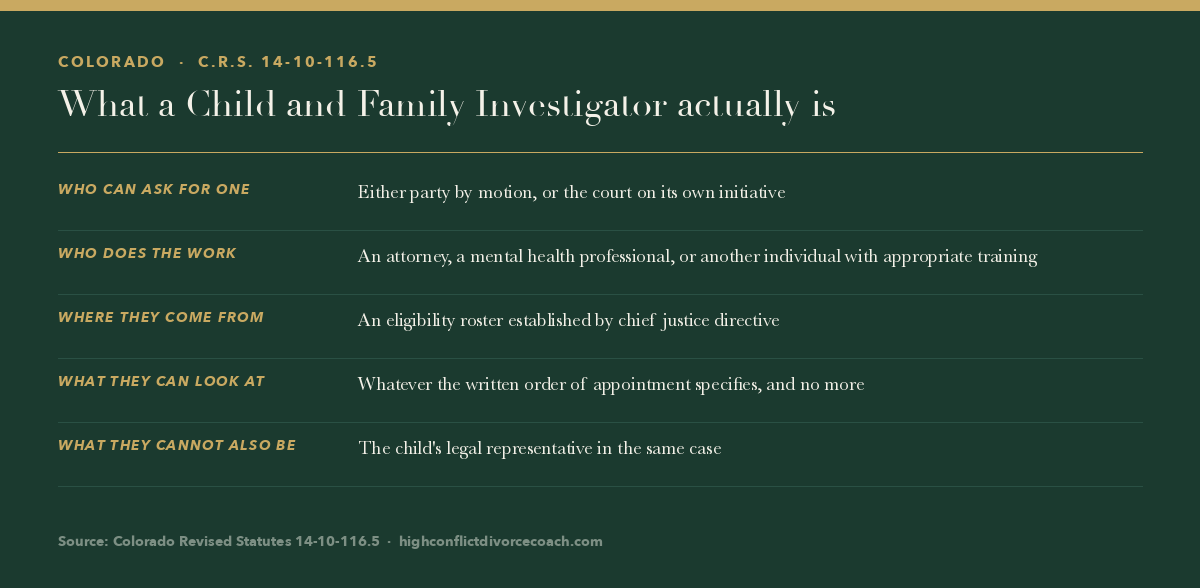
Where parenting arrangements are contested, the court may appoint a neutral professional to investigate and report. In Colorado this is a Child and Family Investigator, appointed under C.R.S. § 14-10-116.5. Most states maintain an equivalent role under a different title.
Two features of that statute are worth knowing, and are rarely understood by the parties. The first is that the appointment may be made on the motion of either party, not solely at the court's own initiative, so where circumstances genuinely warrant independent scrutiny, it can be requested rather than awaited. The second concerns who conducts the work. An investigator may be an attorney, a mental health professional, or another individual with appropriate training drawn from an eligibility roster, and the duties are fixed by a written order of appointment. The scope is therefore bounded. It is defined in a document, and you are entitled to understand what that document permits.
Then the presentation arrives. In my experience the shift is frequently dramatic: an engaged, reasonable, conspicuously concerned parent appears, sometimes for the first time in years. This is disorienting to witness, particularly when other professionals appear to accept it without qualification.
At this point, two years of brief, factual, unremarkable correspondence will do more for you than anything said in an interview. An investigator reads the file rather than a curated selection, and rather than the account either parent would prefer. What withstands scrutiny is consistency across time, not persuasiveness in a meeting.
Prepare, but do not perform. Overpreparation reads poorly, as does arriving with a binder assembled to establish that the other parent is a bad person, which reliably reflects on the party who produced it.
Stage five: settlement or trial
Most cases settle, including difficult ones. Mediation or a settlement conference is standard, and in many jurisdictions it is required before trial.
Expect movement to come late. Agreement on the courthouse steps is a cliché because it occurs, and it is consistent with the underlying dynamic. Settling early concedes the process. Settling at the last available moment preserves the impression of having controlled the timing.
By this stage the file should demonstrate good-faith engagement with settlement. Reasonableness is not a weakness here. It is the most valuable quality you can evidence.
Whatever you sign, read the parenting plan on the assumption that every ambiguity will be construed in the other party's favour, because it will be. Imprecise language is not a minor defect. Phrases such as "reasonable notice" and "as agreed between the parties" are where the following three years of conflict will be located. Insist on specifics: times, dates, locations, responsibility for transport, the consequence of lateness, the method of communication and the period within which messages must be answered.
Stage six: what does not conclude with the divorce
This stage is rarely anticipated, and it is why so many people describe the year following the decree as harder than the proceedings themselves.
The case has concluded, but the parenting plan is operative and enforcement is a separate matter entirely. Post-decree motions are common.
The arena relocates rather than closing. Exchanges, school decisions, medical appointments, holidays, and every provision the plan left imprecise become the new venue. A divorce ends the marriage. Where children are shared, it does not end the relationship.

Move communication onto a structured, documented platform, ideally a parenting application that produces a record, and maintain the discipline established earlier. Then accept a difficult premise: cooperation is not the objective, because cooperation was never available. The objective is a system that functions without it.
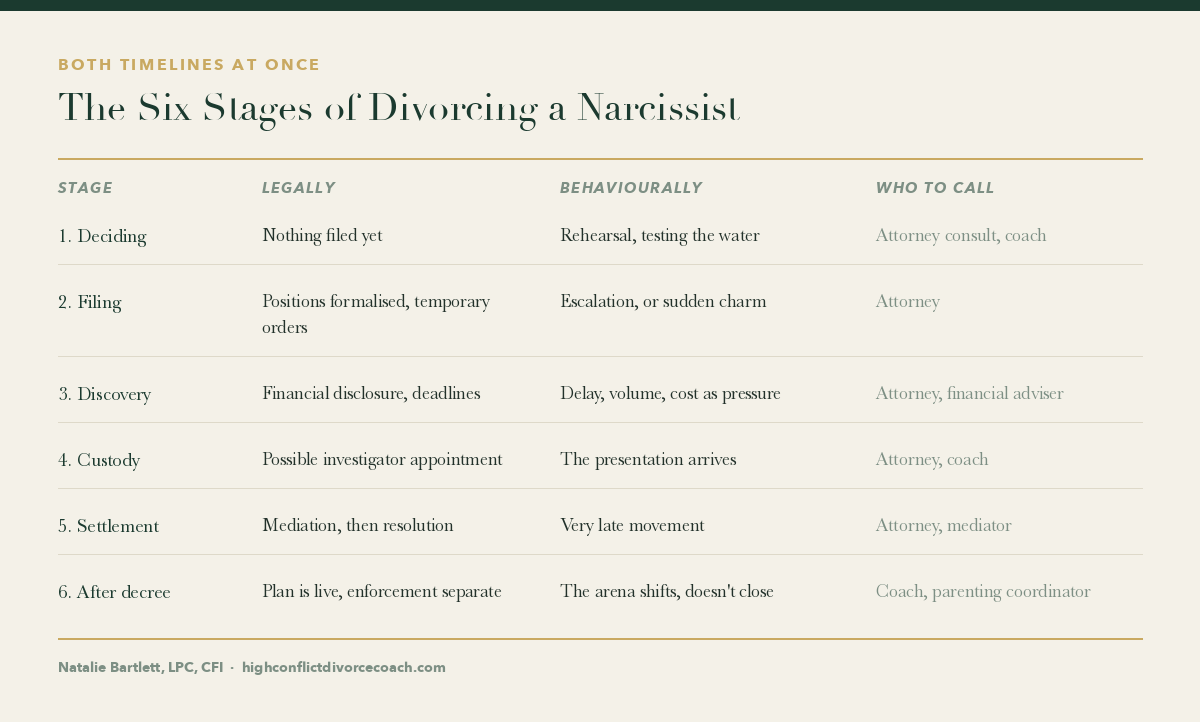
The stages side by side
The six stages in a single view. Use it to locate your present position and to identify what to prepare for next.
How long does this take?
Longer than an ordinary divorce, and I would treat any confident figure with caution. The duration depends on your jurisdiction, your court's backlog, whether children are involved, and how much of the delay in stage three is deliberate.
The more useful guidance is this. Resource the process, financially and emotionally, for a duration that exceeds your expectation, and treat early resolution as an advantage rather than the plan. Those who struggle most are generally those who budgeted for something short.
When it is worth bringing someone in
At a certain point this ceases to be solely a legal problem and becomes a strategic one, and the professionals who address each are not interchangeable. A therapist helps you process the experience. An attorney manages your legal position and is the only person who should advise you on the law. A divorce coach works on the territory between them, which is where most of the durable damage is done, because those decisions are made quickly and usually alone.
That territory is my work. I am a Licensed Professional Counselor and a court-appointed Child and Family Investigator, and the account above derives from twenty-six years of observing how these cases actually proceed rather than how they are designed to.
If you are somewhere in stages one to three, The Focused Work provides three months of applied strategy built around your circumstances. If you are in active litigation or a contested custody matter, The Retained Work provides embedded support for the duration. If you have reached stage six, The Peace Table is designed for communication that must function without cooperation from the other party.
Frequently asked questions
-
Prepare thoroughly before announcing anything, keep communication brief and factual throughout, and obtain advice from someone who understands the pattern rather than general divorce guidance. The greatest advantage available to you is foreknowledge. Almost everything that goes wrong in these cases goes wrong in the moment, under pressure, in response to something that was not anticipated.
-
That is your judgement to make, and I will not make it for you. What I will say is that the question is usually asked during stage three, when cost and delay are at their height and no conclusion is yet visible. That is the most difficult point of the process rather than a representative sample of it. Ask it again with proper support in place, not at the lowest moment.
-
Treat stage six as a project in its own right rather than an afterthought. Move communication onto a documented system, tighten every provision the parenting plan left imprecise, and expect the conflict to relocate rather than end. Those who plan for that year find it considerably more manageable than those who assumed the decree was the finish line.
-
Commonly some combination of escalation, a sudden return of charm, and the recruitment of others to their account of events. The timing generally tracks a loss of control rather than any change of position, which is why the warm phase so often arrives precisely when leaving would be most costly to reverse.
Sources
1. Gutowski ER, Goodman LA. Coercive control in the courtroom: the Legal Abuse Scale (LAS). J Fam Violence. 2022;38(3):527–542.
2. Colorado Revised Statutes § 14-10-116.5, Appointment in domestic relations cases, child and family investigator.