
How to Deal With a Narcissistic Partner
I have spent twenty-six years reading other people's messages. Not as a therapist, though I am one, but as the investigator a Colorado court appoints when it needs an independent account of what is happening inside a family. That work means sitting with the text threads, the emails and the parenting application logs, and reading the whole record rather than the portion either party would prefer to present.
It gives me a particular vantage point on this question. Most advice on managing a narcissistic partner will tell you to set boundaries and disengage. Very little of it mentions that the manner in which you set those boundaries this year may be read aloud in a courtroom two years from now. Some of the most frequently recommended responses read badly when they arrive there.
One further note before we begin. Nothing here assumes which partner in a relationship is the difficult one. The clinical data indicates the pattern is more common in men, and I will come to those figures, but the conduct is not confined to one gender and neither is the guidance. I have worked with clients on both sides of it.
Nor will I tell you to leave. You may decide to, and there are circumstances in which that is the only sound conclusion. But a great many people stay, for reasons that belong to them, and they are usually handed nothing more useful than an instruction to get out. That is not assistance. What follows is what I would tell you across a desk.
The consideration almost nobody raises
Everything you write eventually becomes evidence, though not in any dramatic sense and nobody arrives with a folder. But if this proceeds to a custody dispute, and a substantial proportion of these relationships do, then somebody in my position will read two years of your correspondence and form a view about the kind of parent you are.
That is not a reason to be apprehensive about your own phone. It is a reason to understand what you are building. Most of the guidance below is sound for your own equilibrium in any case. It simply also happens to withstand reading by a stranger, which the conventional version of this advice does not.
Keep it brief, factual, and confined to logistics
If you take one thing from this article, take this. Your messages should state what you will do and when you will do it, and very little else.
There is an established method for this, and it is the one I use with clients. The BIFF response, developed by Bill Eddy at the High Conflict Institute, holds that a reply to a hostile message should be Brief, Informative, Friendly and Firm. Brief means a short paragraph rather than a page. Informative means factual content only, with no interpretation and no defence. Friendly means a neutral opening rather than a warm one. Firm means the message closes the subject rather than inviting a further round.
In practice it produces messages like these. "I will have them back by six." "Thursday does not work. I can do Friday or Saturday." "Received, thank you." That is the entire discipline. No preamble, no softening, and no explanation of your reasoning.
The reason it works is structural. A conversation is fuel. Every additional sentence you write is another surface to push against, another phrase available to be misread deliberately, another opening. Where there is nothing to grip, most of these exchanges eventually run out of energy. Not immediately, and not pleasantly, but they do.
It also holds up under later scrutiny. Brief factual messages read as a reasonable person managing arrangements, which is all that is required. You do not need to appear clever, and you certainly do not need to win the exchange. The parent whose correspondence reads as calm and organised across two years occupies a strong position without ever having attempted to.
Expect escalation at first. When a familiar reaction stops arriving, most people press harder to retrieve it, so anticipate a period in which messages become longer, more provocative or more insulting. Continue answering only the practical component. "I will have them back by six" is a complete response to a message that also questioned your stability.
There is a limit to what this achieves. Where messages arrive twenty times a day, or the content has moved into threats, the method manages your exposure but does not resolve the problem. The conversation to have then is with your attorney, about a communication order or a monitored parenting application.

Stop explaining yourself
This is the most difficult adjustment, and the one I spend most time on with clients.
The impulse to explain is entirely reasonable. If the other person simply understood your reasoning, surely they would accept it, and being thought badly of unfairly is genuinely painful. The explanation feels as though it will repair that.
It does not, because the explanation is not received as an explanation. It is received as an opening position in a negotiation you did not know you had entered. Every reason offered is a reason available to be disputed. Offer five, and you have supplied five points of contention in place of one decision to be accepted.
There is a further consequence that surprises people. Long, defensive, emotionally detailed messages do not read as a wronged person explaining themselves. Read cold, months later, by somebody who knows neither of you, they read as a person who is not coping, while a three-line reply reads as the composed one. I have watched this dynamic resolve the same way more times than I can count, and it is almost invariably the more articulate and more emotionally honest parent who is disadvantaged on paper.
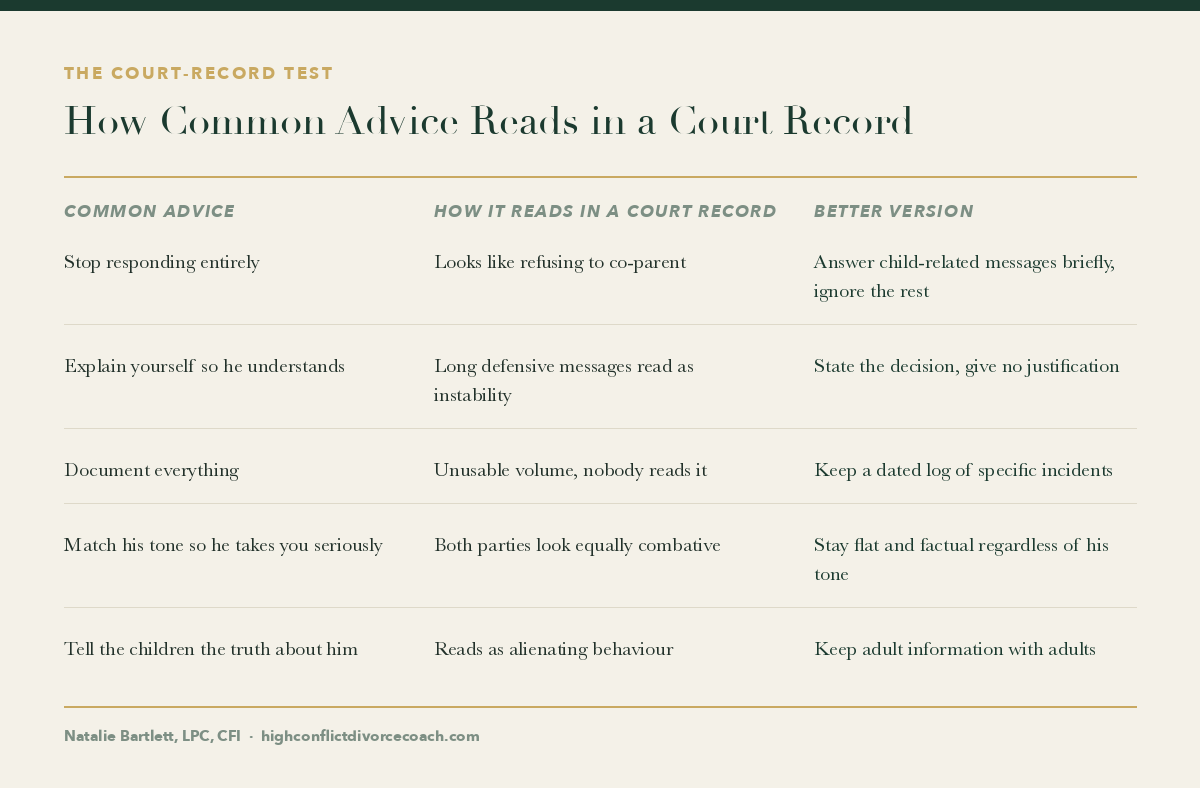
State the decision and stop there. "I have decided the children will not be doing that." You are entitled to make decisions about your own household without submitting your reasoning for approval.
The exception is narrow. Where something genuinely requires context, provide it once, briefly, and do not repeat it when challenged. Repetition reads as uncertainty.
Is it them, or is it me?
Almost everyone I work with asks a version of this, usually apologetically, and often after years of being told they are too sensitive.
The evidence is reasonably clear. The largest study of its kind in the United States, based on face-to-face interviews with more than thirty-four thousand adults, identified narcissistic personality disorder in approximately 6% of the population. It was more prevalent among men than women, at roughly 7.7% against 4.8%, and it was markedly more common among people who were separated or divorced. The pattern is real, it is not rare, and it appears disproportionately in precisely the circumstances you are in.
Two further findings from that study are worth knowing.
The first is that the disorder was associated with genuine impairment in men but not in women. I mention it because of how these relationships are typically explained to the person on the receiving end, sometimes by the partner and sometimes by people who mean well: that they are mishandling the situation, or asking too much. What you are dealing with is a documented and impairing pattern, not a deficiency in your patience.
The second cuts the other way, and I include it because I would rather be accurate than reassuring. The authors concluded that the condition "may not be as stable as previously recognized." Most writing on this subject asserts flatly that such people never change. The research is less settled than that. I am not suggesting your partner will change, and I would be cautious about constructing a plan around the possibility, but anyone claiming certainty in either direction has moved beyond the evidence.
Should you attempt couples counselling?
You can, and many people wish to, but enter it with a clear view of the likely outcome.
There is relevant research. When narcissistic traits are measured properly they resolve into two distinct presentations: grandiosity, the overt entitled version most people picture, and vulnerability, which presents as fragility and wounded resentment. A study of therapy outpatients found that grandiosity predicted early termination of therapy by the client, while vulnerability did not.
In practical terms, the more grandiose the presentation, the more likely it is that your partner is the one who leaves the process.
Attempt it if you wish, but do not construct your plan around their continued participation, and do not treat agreement to attend as evidence that circumstances are changing. Agreeing to attend and sustaining the work are materially different things.
One caution carries more weight than the rest. Couples work presumes both parties are safe to be candid in the room. If you would face consequences at home for something said in a session, couples counselling is the wrong setting, and a competent therapist will tell you the same. Individual therapy generally achieves more, because you are not managing another person's reaction while attempting to speak.
Keep a record somebody will actually read
Almost everyone instructed to document does it incorrectly, and it costs them.
Record what carries weight: missed and late exchanges, cancelled parenting time, specific statements made in front of the children, and financial decisions affecting the household. Write entries the same day, keep them short and factual, and date every one. "Arrived fifty minutes late, no message" is useful to everybody who eventually reads it. "Impossible again" is useful to nobody.
Preserve threads whole. Screenshot the complete exchange rather than the single line that proves your point, because a line lifted from its context invites the argument that you have been selective, and that argument succeeds.
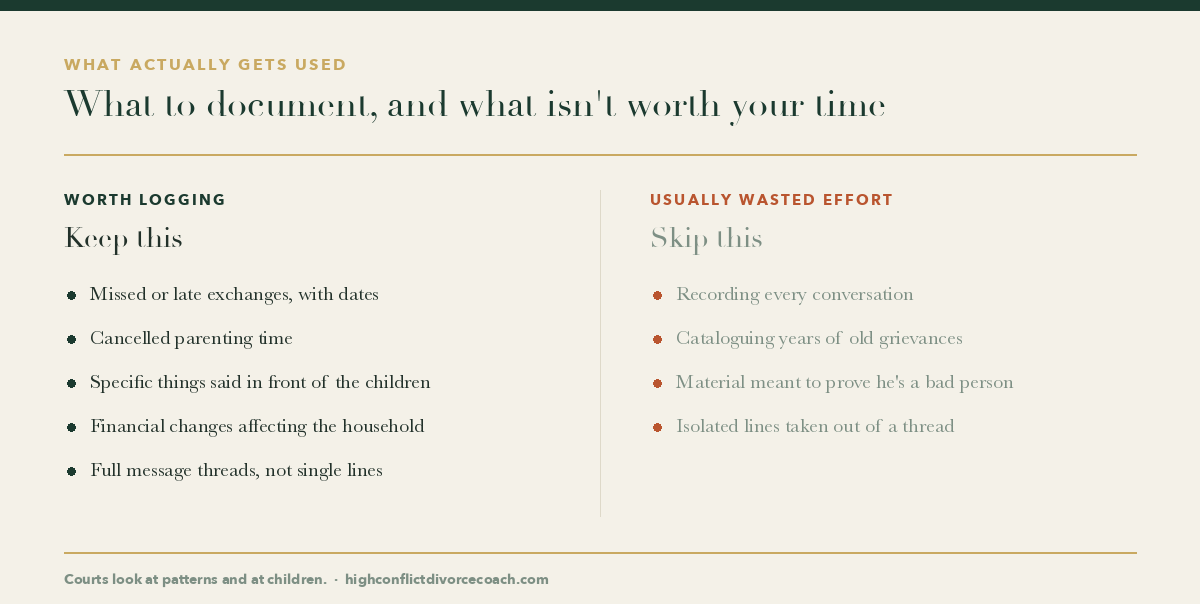
Certain effort is wasted entirely. Recording every conversation, cataloguing years of grievance, and assembling a case that the other parent is a bad person rather than a pattern that affects the children. Courts are concerned with patterns and with children. Character evidence about a former partner has a reliable tendency to reflect on whoever produced it.
The distinction matters more than people expect, because the conduct has been formally studied. Researchers have constructed and validated a measure of how court processes are used as a weapon after separation, developed with more than two hundred mothers who had been through family proceedings. The tactics it captures are specific: repeated filings, threats to pursue custody, false representations about a parent's character made to professionals, and allegations that one parent is damaging the children's relationship with the other. That study examined mothers, but the conduct is not confined to one gender, and I have seen it run in both directions.
Read that list again, because it is a preview. If matters proceed that way, the case will not be about the other party. It will concern your character, your stability, and whether you supported the children's relationship with their other parent. Four thousand pages prove nothing. Twenty dated entries establishing a pattern, alongside two years of composed logistical correspondence, prove a great deal.
Before sending anything, apply one test: would you be comfortable hearing it read aloud in a courtroom? If not, write it again. Not because the feeling behind it is wrong, but because the record is the wrong place to put it.
Are you managing, or are you leaving?
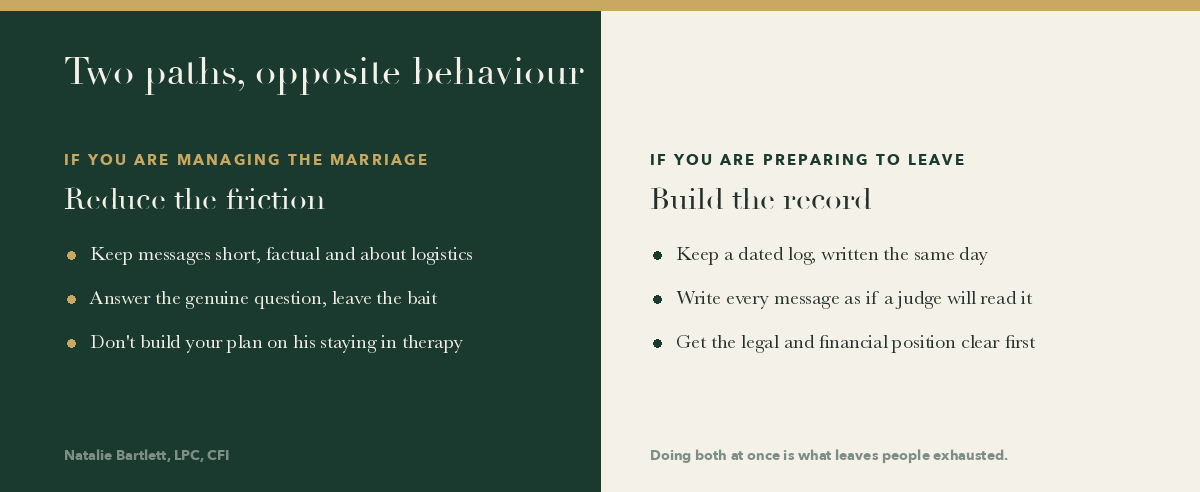
These require opposite conduct, and remaining undecided is the most expensive position available.
Managing means lowering the temperature and keeping the household functioning. Leaving means building a record and establishing your legal and financial position before the other party is aware of it. Most people attempt both for years and achieve neither: a relationship that has not improved, and a paper trail that does not assist.
A few questions tend to settle it.
Has anything genuinely improved across two years, as distinct from improving for a fortnight following a crisis?
Are the children being used as messengers, or as leverage?
Have you stopped saying certain things aloud in your own home because of what follows?
Are you managing a relationship, or managing a person?
None of that obliges you to leave. It identifies which set of conduct you should be following, and that determination is far better made deliberately than arrived at through exhaustion.
When this is not a communication problem
I want to be precise about something the internet routinely confuses. Narcissism and abuse are not the same thing. Many people with narcissistic traits are not abusive, and many abusers have no narcissistic traits whatever.
If you are afraid of your partner, managing your own behaviour to avoid their reaction, or have been hurt or threatened, the question before you is not what they are. It is whether you are safe. That is a different conversation requiring different resources, and it takes precedence over everything above. In an emergency, call 911.
When it is worth bringing someone in
At a certain point this ceases to be a relationship problem and becomes a strategic one, and the professionals who address each are not interchangeable. A therapist helps you process the experience. An attorney manages your legal position. A divorce coach works on the territory between them, which is where most of the durable damage occurs, because those decisions are made quickly, under pressure, and usually alone at eleven at night.
That territory is my work. I am a Licensed Professional Counselor and a court-appointed Child and Family Investigator, and the guidance above derives from twenty-six years of observing how these situations actually unfold rather than how they are supposed to.
If you are at the point of decision, a single focused conversation is often sufficient to see the shape of things, and The First Hour is built for exactly that. If you are already co-parenting alongside this, The Peace Table is designed for communication that must function without cooperation from the other party.
Frequently asked questions
-
Answer the practical question and nothing further, stating what you will do and when. Leave the provocation alone, and resist justifying your decisions, because every reason offered becomes another point of contention. Brief and factual also happens to be what reads well if the correspondence is ever produced in court.
-
The reliable indicator is pattern rather than incident. Small decisions become disputes, settled agreements are reopened, conversations are managed around one person's reaction, and children are positioned as messengers. A single difficult period does not establish the pattern. The same conduct recurring across months or years does.
-
The attachment is frequently genuine, but it tends to be conditional, and the condition is usually how well the partner reflects on them. That is why affection can be entirely sincere and still disappear the moment you disagree in front of somebody else, and why warm periods are not evidence that anything fundamental has shifted. They belong to the same pattern rather than representing a departure from it.
-
Generally not, and the attempt tends to escalate matters. What remains within your control is how much material each exchange supplies. Brief, level, factual replies remove the fuel without providing anything usable later. It is not the satisfying answer, but it is the one that works.
Sources
1. Stinson FS, Dawson DA, Goldstein RB, et al. Prevalence, correlates, disability, and comorbidity of DSM-IV narcissistic personality disorder. J Clin Psychiatry. 2008;69(7):1033–1045. PMID 18557663.
2. Ellison WD, Levy KN, Cain NM, Ansell EB, Pincus AL. The impact of pathological narcissism on psychotherapy utilization, initial symptom severity, and early-treatment symptom change. J Pers Assess. 2013;95(3):291–300.
3. Gutowski ER, Goodman LA. Coercive control in the courtroom: the Legal Abuse Scale (LAS). J Fam Violence. 2022;38(3):527–542.
4. Eddy B. How to write a BIFF response. High Conflict Institute. BIFF Response® is a registered method developed by Bill Eddy in 2007.