
What Does a Divorce Coach Do, and Is One Worth It?
A divorce coach helps you make decisions during a divorce. Not the legal decisions, which your lawyer handles. The hundreds of smaller ones in between.
Most people find this page for one of two reasons. They want to know what a divorce coach actually does. Or they want to know if it's worth the money. I'll answer both. I'll also tell you when it isn't worth it, which most coaching websites won't.
This is my job, so keep that in mind. What I can offer is twenty-six years working inside the family court system. I'm a licensed counselor. I'm also the investigator Colorado courts appoint when they need to know what's really happening in a family.
What does a divorce coach do?
A divorce coach works on your decisions and your strategy. During a divorce you face a lot of choices. Do you reply to that message? Do you agree to swap weekends? Should you move out? Should you accept the offer or push for more? What do you tell the children? Do you email your lawyer at midnight, or wait?
Your lawyer handles the big legal ones. Nobody handles the rest. And the rest is most of them.
Here is what the work covers.
Getting ready. Your documents, your finances, your notes on what happened. In order early, not scrambled together later.
Your messages. What you send, how you word it, and how it will look to a judge two years from now.
Strategy between the legal steps. Your lawyer tells you what the law allows. A coach helps you decide what to actually do.
Using your lawyer well. Lawyers are expensive. A lot of that money gets spent on questions that aren't legal questions. A coach costs less for those.
Sticking to the plan. Knowing what to do is the easy part. Doing it for eighteen months, while someone tests you every day, is not.
How is a divorce coach different from a lawyer or a therapist?
This is where people get confused, and getting it wrong costs money. A lawyer handles the law. They file documents, negotiate, and represent you in court. Only a lawyer can give you legal advice.
A therapist helps you cope. If you're not sleeping, or you're grieving, that's the right person. A therapist isn't trying to help you win a custody case. A divorce coach handles what happens in between.
One way to put it. A therapist helps you with yesterday. A lawyer handles next month. A coach helps you with this afternoon. Many people need more than one at the same time. That's normal.

What does a high conflict divorce coach do differently?
Most divorce coaching assumes both people want it over with. High conflict work assumes they don't. In these cases, one person isn't trying to finish. They're trying to win. Or they're trying to make the process itself hurt. Any advice that assumes the other side will calm down eventually stops working.
So the work changes. Your messages get written for a judge to read later, not to win the argument now. Your notes get built around what a court will actually use. Delay and blow-ups get planned for, instead of surprising you. And the goal stops being a better relationship. The goal becomes a system that works without their cooperation.
How much does it cost?
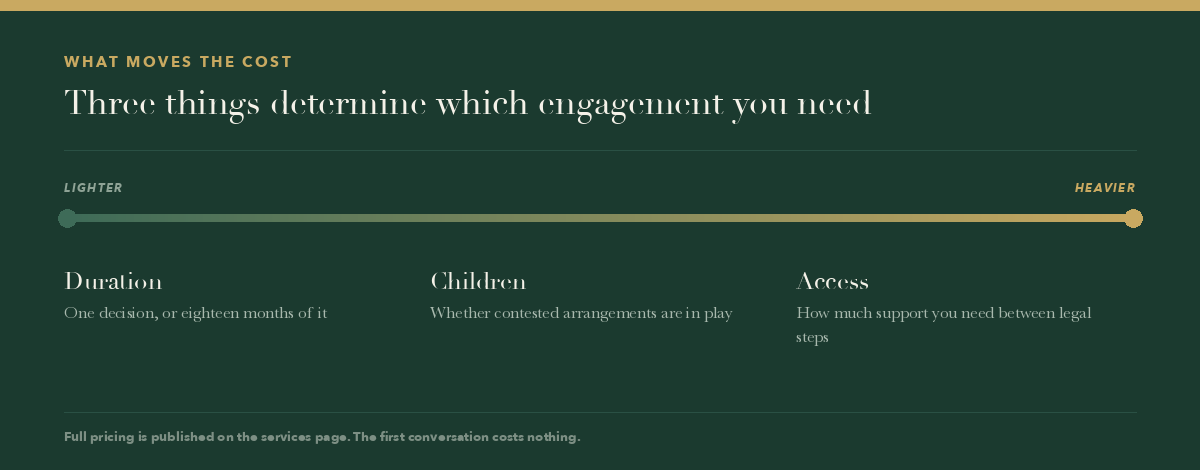
There's no reliable industry figure, and I'm not going to make one up. What I can tell you is what changes the price. Three things.
How long it runs. One conversation about one decision is very different from six months of support.
Whether children are involved. Contested custody costs more, in every sense.
How much access you need. Some people want a session when something happens. Others need someone available throughout.
Ask any coach for their full price list before you commit. If they won't give you one, that tells you something. Mine is on the services page, and the first conversation is free.
Is a divorce coach worth it?
Sometimes. It depends on what's making your divorce expensive. It's usually worth it if:
Your legal bills are going on things that aren't legal questions. Paying a lawyer's hourly rate to talk about whether to answer a text is expensive.
The other side isn't going to become reasonable, and everything you've tried assumes they will.
There are children and you're fighting about custody. Those decisions last for years, and some can't be undone.
You keep making big decisions at 11pm, on your own, and living with them afterwards.
When it isn't worth it
Here's the part you won't usually read on a coaching website. If your divorce is friendly, you don't need this. If the two of you can agree without fighting, a mediator or a good lawyer will cost you far less.
If you're not coping, get a therapist first. Coaching asks you to act on a plan. If you don't have the energy for that right now, it won't help you. There's nothing wrong with that being where you are.
If your question is a legal question, spend the money on a lawyer instead. If you're hoping it will change the other person, it won't. None of this works on the other person. Any coach who suggests otherwise is selling you something they can't deliver.
And if paying for it would put you under real financial strain, don't. That strain is bad for you and bad for your children. One session, or the free conversation, is a perfectly good use of this. A six-month package you can't afford is not.
How do you choose one?
Divorce coaching isn't regulated. Anyone can call themselves one. So the choice matters more here than in most fields. Four things to ask.
What's their actual background? Coaching certificates vary a lot. A professional licence means someone independent checked their work and can take it away.
Have they seen how these cases end? Or only how they start?
Are they clear about where their job stops and a lawyer's begins?
Will they tell you not to hire them? That's the most useful thing a good one can say.
For the record, here's mine. Licensed Professional Counselor #3250 with the Colorado Department of Regulatory Agencies. Court-appointed Child and Family Investigator. Twenty-six years inside the family court system, including expert witness work, mediation, and supervised parenting time. I'm not listing it to sell you anything. I'm listing it because you should ask this of everyone.
Where to start
If you're not sure what you need, the first conversation is free. That's the quickest way to find out. You can get in touch, or read how the engagements work.
If you already know your situation is high conflict and you want a plan, The Focused Work is where most people start. If you're co-parenting with someone who won't co-parent, The Peace Table is built for that.
Frequently asked questions
-
Rates vary a lot and there’s no reliable industry average, so be careful with any single number you see. What changes the price is how long you need support, whether there’s a custody fight, and how often you need access. Ask for a full price list before you commit. Mine is on the services page.
-
Not if your divorce is friendly. Often yes if your legal bills are going on things that aren't legal questions, if the other side won't become reasonable, or if you're fighting about custody. The simple test: are the decisions you're making under pressure costing you more than a coach would?
-
Usually the middle, when costs are climbing, the other side is dragging things out, and you can't see the end. It's also when most people ask whether it's worth continuing. Worth remembering: the worst part of a process isn't a fair picture of the whole thing.
-
Writing something that felt completely justified at the time. In a contested case your messages become evidence. The parent who sounds calm across two years of messages is in a strong position, without ever trying to be. The second biggest mistake is paying a lawyer's hourly rate for something that isn't a legal question.