
High Conflict Divorce: What It Means and What Helps
A high conflict divorce is a divorce where the fighting doesn't stop. Not because the issues are hard, but because one person keeps the fight going. Sometimes both.
Most divorces settle down. The paperwork ends and people move on. In a high conflict divorce that never quite happens. The court dates keep coming. The messages stay hostile. Years can pass this way.
I've spent twenty-six years inside these cases. I'm a licensed counselor, a mediator, and the investigator Colorado courts appoint when they need to know what's really going on in a family. This page explains what a high conflict divorce is, what it does to children, and what actually helps.
What does high conflict divorce mean?
Researchers have studied this for over thirty years, and they use a real definition. It's not just a divorce that feels bad.
A divorce counts as high conflict when three things keep happening after the split: aggression, open hostility, and distrust. Verbal attacks. Sometimes physical ones. Neither person believes a word the other says.
Notice what's on that list. Ongoing behaviour. Not one terrible fight. Not a hard custody negotiation that eventually settles. The pattern is what makes it high conflict, and the pattern is what does the damage.
Every divorce has bad weeks. If yours settled after the decree, it was probably a normal divorce that hurt. High conflict means it keeps going.
What are the signs?
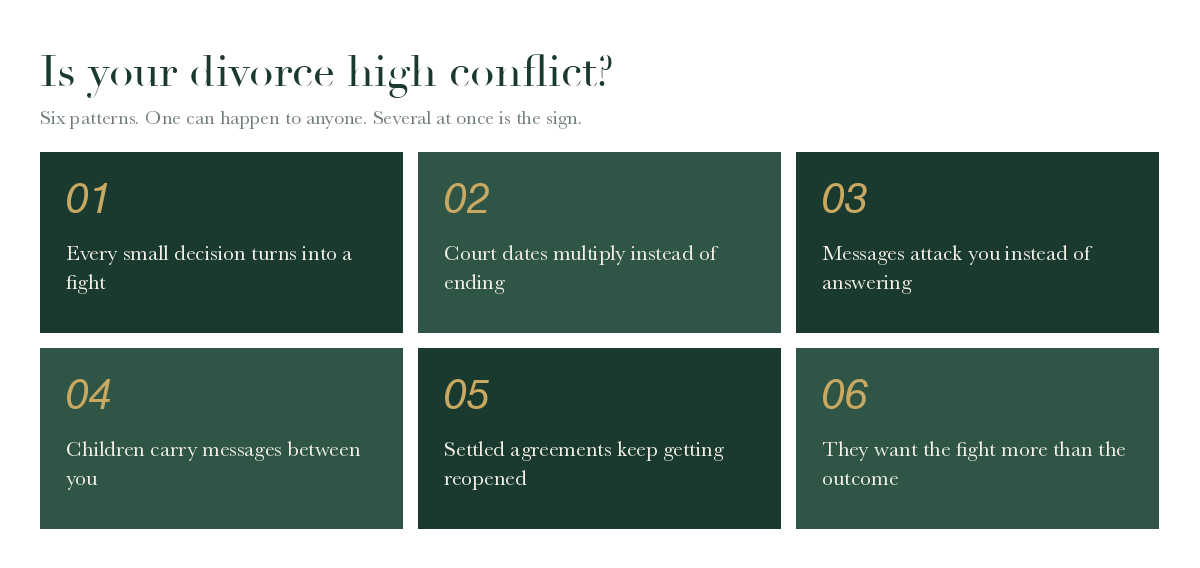
You usually can't tell from one event. You can tell from the pattern.
There's one more sign that people miss. You've started changing your own behaviour to avoid a reaction. What you write, what you say, what you agree to. When one person is managing everything around the other person's temper, that's not a normal divorce.
What does it do to children?
This is the hard part to read, and I'd rather you knew it than not.
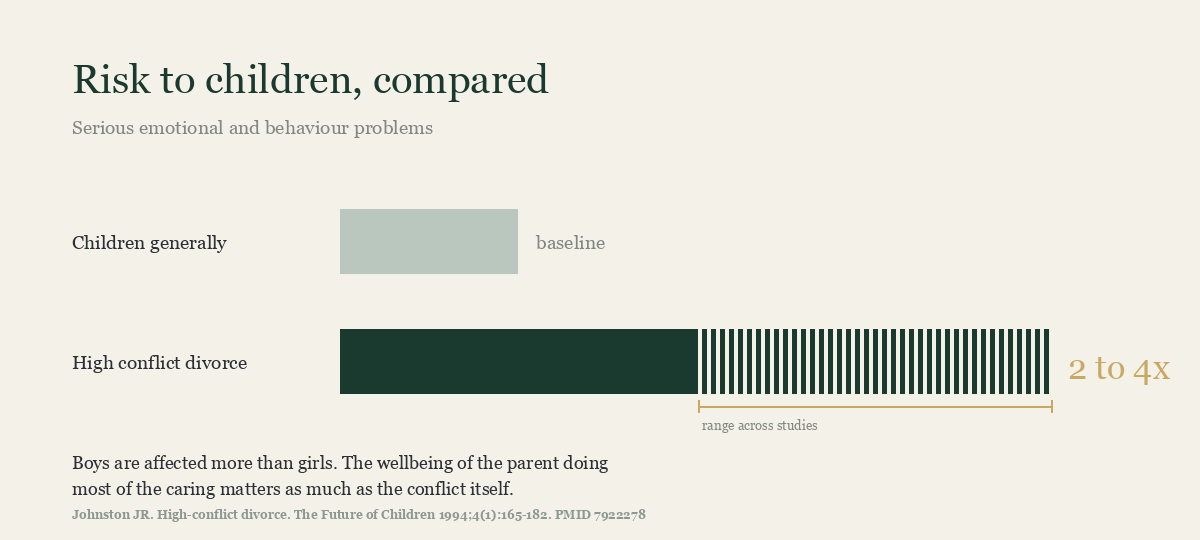
The biggest research review on high conflict divorce looked at what happens to these children. They are two to four times more likely to have serious emotional and behaviour problems than other children, and boys more so than girls.
Divorce is on the official list of childhood adversities. The CDC counts "parents or guardians separated or divorced" as an Adverse Childhood Experience, alongside things like violence in the home and a parent's mental illness. Adversity in childhood is also common. In the 2021 to 2022 National Survey of Children's Health, 21.3% of American children had experienced one adverse childhood experience, and another 17.4% had experienced two or more.
I include that for balance, not to frighten you. Being on a list is not a verdict on your children. What the research keeps showing is that outcomes depend heavily on what happens around the child, and that is the part you can affect.
But the same research found two things every parent in this situation should know.
First, it isn't just the fighting that harms children. It's the fighting plus a worn-down parent. The wellbeing of the parent doing most of the caring matters as much as the conflict itself. So looking after yourself is not a luxury. It's protection for your kids.
Second, the researchers found something that surprises most people. In high conflict cases, court orders for joint physical custody and frequent back-and-forth visits were linked to worse outcomes for children, especially girls. More contact did not mean better, when the conflict stayed high.
I want to be careful with that finding. It's about patterns across many families, not about your family. What's right in your case is a question for your lawyer and your court. But it matters. The pressure in family court usually runs the other way, and parents deserve to know what the research actually says.
How do you deal with a high conflict spouse?
You stop trying to win the argument, and you start protecting the record.
Keep your messages short, factual, and about logistics only. Say what you'll do and when. Don't explain, don't defend yourself, don't answer insults. Answer the question and leave the rest.
Here's why. In a high conflict divorce, your messages become evidence. Someone like me may read two years of them. The parent who sounds calm and organised across those two years is in a strong position without ever trying to be.
Before you send anything, use one test. Would you be comfortable hearing a judge read it out loud? If not, rewrite it.
And keep a simple log. Dates, missed exchanges, cancelled parenting time, things said in front of the children. Short entries, written the same day. That beats a thousand pages of screenshots every time.
What actually helps?
Three things, and they're not the ones people usually try first.
The right professional for the right problem. A lawyer for the law. A therapist if you're not coping. A coach for the daily decisions in between. Most expensive mistakes happen when people take the wrong problem to the wrong person.
A plan that doesn't need the other person to change. Anything that depends on them becoming reasonable will fail. Build a system that works without their cooperation: structured communication, a documented parenting app, specific times and dates in the parenting plan instead of vague ones.
Support early, not late. Researchers who study these families now push for help at the start of the process, not after years of damage. The earlier the conflict gets managed, the less of it your children absorb.
One thing doesn't help, and it's the thing everyone tries: waiting for the other person to calm down. In a true high conflict case, they don't. Plan for that instead of hoping against it.
Where to start
If this page sounds like your divorce, you don't have to work it out alone. The first conversation is free. You can get in touch, or read how the engagements work.
If you're in the middle of it and need a plan, The Focused Work is where most people start. If the divorce is done but the conflict isn't, The Peace Table is built for co-parenting that has to work without cooperation.
Frequently asked questions
-
Longer than a normal divorce, and nobody honest will give you an exact number. The legal case alone can run for years when one side uses delay as a tactic. And with children involved, the
conflict often continues after the decree. Plan your money and your energy for a long process, and treat an early end as a bonus.
-
Researchers look for three things that keep happening after separation: aggression, open hostility, and deep distrust between the parents. The key word is pattern. One bad stretch doesn't make a divorce high conflict. The same behaviour repeating for months or years does.
-
Don't answer the rage. Answer the question, if there is one, in one or two factual sentences. Never defend your character in writing. Long defensive replies read badly in court later. If an accusation is serious, tell your lawyer instead of arguing with your ex.
-
Budget for it being long. Get the right professional for each problem instead of using your lawyer for everything. Keep your messages boring and your log short. Take care of your own health. The research shows your wellbeing directly protects your children. And remember that the worst stretch is the middle, not the whole story.
Sources
1. Johnston JR. High-conflict divorce. The Future of Children. 1994 Spring;4(1):165–182. PMID 7922278. — the research definition, the two-to-four-times figure and the finding that boys are affected more than girls, the parent-wellbeing finding, and the joint-custody finding. Cited over 590 times.
2. Children's Safety Network. Adverse Childhood Experiences factsheet, October 2024. Prevalence data from the 2021–2022 National Survey of Children's Health (NSCH). — the CDC classification of parental separation/divorce as an ACE, and the 21.3% / 17.4% prevalence figures.
3. O'Hara KL, Cohen B. A call for early, effective, and scalable parent education programs for high-conflict separated/divorcing parents. Family Court Review. 2024 Jan;62(1):160–175. PMID 38495867. — support early, not late.