
Separated But Living Together: How to Navigate It Without Losing Ground
Being separated but living together is far more common than most people realise. Sharing a home with the spouse you are separating from is an ordinary outcome, not an unusual one. The finances rarely allow for an immediate move-out. When children are involved, staying under one roof a little longer is often the more stable option, not the weaker one. The hard part is not the decision to stay. It is living it day to day without the arrangement quietly working against you.
This looks at why people end up separated but still living together, and what tends to make it work. It also covers how to set real ground rules, and when it is time to reconsider the arrangement entirely.
The short version
Sharing a home during separation is common, not a sign of doing it wrong. Financial and parenting logistics are the usual reasons.
What separates arrangements that work from ones that do not is mostly practical. Separate sleeping space, a rough end date, clear finances, and a low-drama way to communicate.
Escalating conflict, ignored boundaries, or any pattern of control or monitoring are signs to reconsider the arrangement, not to push through it.
This is a practical and emotional question rather than a legal one. For how it may affect your specific case, that is a conversation with your own attorney.
Why people stay under one roof while separating
A few reasons come up again and again.
Neither person can afford to move out immediately. Selling or leaving a shared home takes time. Children are mid school year, and a sudden change feels riskier than staying. Or the couple genuinely is not sure yet whether the marriage is over, and wants space without a full separation.
None of these are signs of doing it wrong. They are ordinary, practical constraints. The arrangement itself is not the problem. How it is handled is what determines whether it helps or hurts.
What actually makes this work
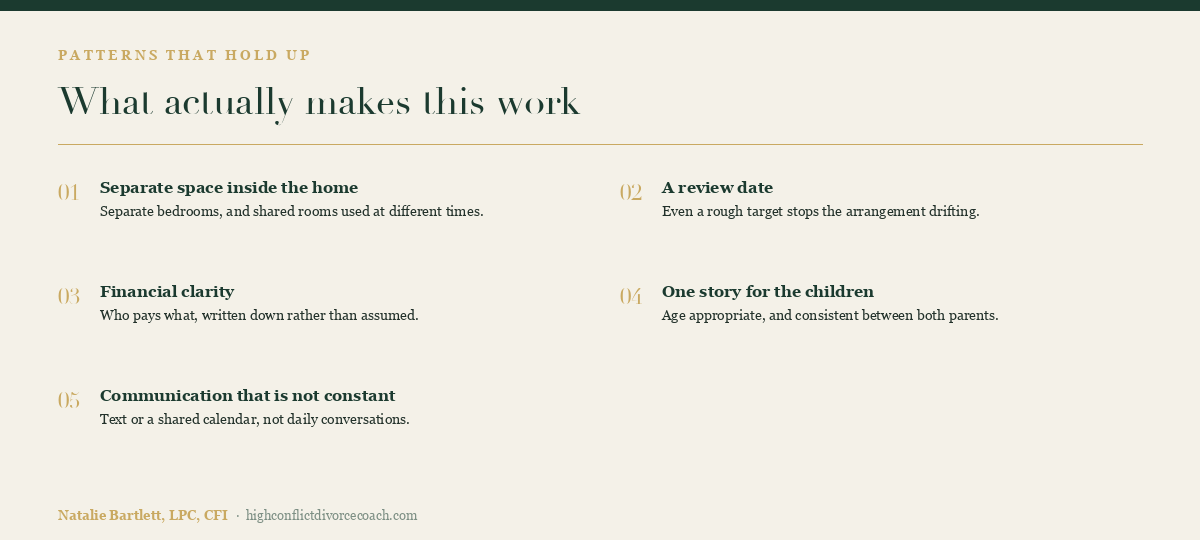
A handful of patterns show up consistently in situations that go reasonably well.
Physical separation inside the home. Separate bedrooms, and where possible separate use of shared spaces at different times. Not continuing to share a bed or a daily routine as though nothing changed.
A defined end point or review date. Even a rough target, such as reassessing in three months, keeps the arrangement from drifting indefinitely.
Financial clarity from the start. Who pays what, and how shared expenses get split, discussed and written down rather than assumed.
Consistent messaging to children, if there are any, about what is actually happening. Age appropriate, not detailed, but not contradictory between parents either.
A communication method that is not constant. Text or a shared calendar for logistics, rather than ongoing in-person conversations that can drift back into old patterns.
What tends to make it worse
The situations that go badly usually share a different pattern.
The physical living arrangement never actually changes, so it is the same bedroom and the same routines. One person treats the arrangement as reversible and keeps pushing to talk things through. Or disagreements about the relationship spill into disagreements about the household, and who does the dishes becomes a proxy fight for the marriage itself.
In a higher conflict dynamic specifically, this setup can become something else. It can be a way for one person to monitor, control or wear down the other, simply by being present around the clock. That is a materially different situation from an amicable, practical arrangement. It is worth naming clearly rather than assuming it will settle on its own.
Setting ground rules that actually hold
Vague intentions rarely survive daily friction.
What tends to hold up is something closer to a short written agreement, even an informal one. It covers separate sleeping arrangements, agreed shared spaces and quiet hours, and how bills get split and paid. It also sets what happens with each person's mail, packages and personal space. If there are children, it includes a rough version of who handles which routines, so it does not get renegotiated every single day.
None of this needs to be a legal document to be useful. Its value is in reducing the number of decisions that get made in the heat of the moment.

Co-parenting under the same roof
When children are part of the picture, the same principles apply with more weight.
Children tend to pick up on tension long before anyone says anything directly. Consistency between both parents matters more than either parent managing the situation alone, even informally, and even before anything is finalised.
Splitting daily routines into clearly assigned blocks tends to reduce friction. School pickup, mealtimes and bedtime work better handled by one parent at a time. It beats both parents hovering over everything. It also gives each parent real, uncontested time with the children, even inside a shared house.
When it is time to reconsider the arrangement
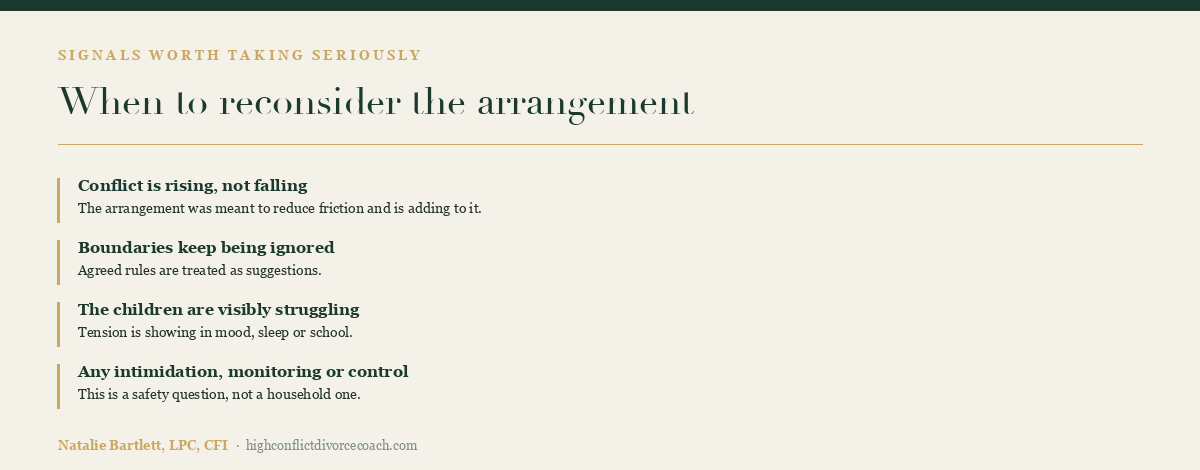
Some signs are worth taking seriously rather than pushing through.
If the arrangement is not reducing conflict but escalating it. If one person consistently ignores agreed boundaries. If children are visibly distressed by the ongoing tension. Or if there is any pattern of intimidation, monitoring or control. Any of these is a signal that the shared household approach may be doing more harm than an earlier move would.
In situations involving coercive control, threats or any physical safety concern, staying under the same roof is not simply inconvenient. It can be genuinely unsafe, and that calls for a different kind of planning entirely. The offers free, confidential safety planning at 1-800-799-7233. If there is immediate danger, that is a 911 call, not a household negotiation.
Where coaching fits into this stage
Living separated under one roof is exactly the kind of stretch where a clear head and a steady plan matter more than usual. There is no space to fully step back, and every small interaction is still happening in person.
This is squarely the layer a high conflict divorce coach works in. Building the ground rules. Preparing for the conversations most likely to go sideways. Helping you recognise early whether the arrangement is genuinely working or quietly deteriorating.
It is not legal advice, and it does not replace an attorney for anything involving the marriage itself. But it is often the difference between an arrangement that holds and one that collapses into daily conflict. covers what that support looks like in practice, and is built for exactly this early, high-stakes stage.
Frequently asked questions
-
Yes. Financial constraints, shared housing costs and parenting logistics make it a common arrangement rather than an unusual one, especially in the early stages of a separation. Many couples stay under one roof for months while they work out what happens next, and that is not a sign the separation is failing.
-
That depends on legal and financial specifics that vary by situation and location. A licensed attorney in your area is the right source for how it may affect your particular case. It is worth asking early rather than late, because some decisions made inside a shared household are harder to unpick afterwards.
-
Clear, specific, written down agreements tend to work better than general intentions. Cover physical space, communication method, finances and, if applicable, parenting routines. Writing it down is not about formality. It removes the need to renegotiate the same point every time it comes up.
-
Not always. If there is any pattern of intimidation, monitoring or control, or any safety concern, that changes the calculus significantly. A different kind of planning is worth pursuing, including professional safety planning. The National Domestic Violence Hotline provides that free and confidentially.
-
When the arrangement is increasing conflict rather than reducing it, when agreed boundaries keep getting ignored, or when children are visibly struggling with the tension. At that point it is worth reconsidering rather than pushing through. Staying longer is not automatically the more responsible choice.
About the author
Natalie Bartlett, LPC, CFI is a Licensed Professional Counselor (#3250) and court-appointed Child and Family Investigator based in the Denver metro area, serving courts across Colorado. Over twenty-six years she has served as a CFI, testified as an expert witness, worked as a mediator, supervised parenting time, and coached clients through high conflict divorce and custody matters.
Disclaimer The information provided in this article is for general educational and informational purposes only. It does not constitute, and should not be relied upon as, legal advice, therapeutic or mental health advice, medical advice, or professional counseling of any kind.
High Conflict Divorce Coach provides strategic divorce and co-parenting coaching. It does not provide legal services, psychotherapy, counseling, diagnosis, or treatment. While Natalie Bartlett holds a license as a Licensed Professional Counselor, she does not provide therapy, counseling, or clinical services through High Conflict Divorce Coach, and no therapeutic or counseling relationship is created by reading this content or by engaging High Conflict Divorce Coach for coaching services.
Reading this article does not create a coaching, counseling, or professional relationship of any kind. Every situation is different. Nothing here should be acted upon without consulting a qualified attorney, licensed mental health professional, or other appropriate professional regarding your specific circumstances.
If you are experiencing a mental health crisis or emergency, contact a licensed professional or emergency services immediately. If you are in immediate danger, call 911.