
What Is a Co-Parenting Coach, and Do You Need One?
A co-parenting coach works specifically on the logistics and communication of raising children across two households. Not on the marriage, and not on general parenting struggles like tantrums or screen time. Perhaps you are searching for a co parenting coach because the other parent will not cooperate. Perhaps they will not communicate reasonably, or seem to be actively working against a stable arrangement. That is exactly the situation this kind of coaching is built for.
This covers what a co-parenting coach actually does day to day, and how it differs from therapy, mediation and general parent coaching. It also covers how to tell whether it is the right fit before reaching out.
What a co-parenting coach actually does
The work centres on building a communication and logistics framework that holds up under pressure.
How handoffs happen. How decisions get made. How messages get exchanged without spiralling into conflict. How to respond when the other parent does not follow through.
A coach does not mediate between two willing parties trying to find middle ground. In a genuinely high conflict situation, that assumption often does not apply. The more realistic goal is a structure that functions whether or not the other parent cooperates. Waiting for cooperation that may never come is not a plan.
How this is different from parenting coaching, therapy and mediation
These get confused constantly, and mixing them up wastes time and money.
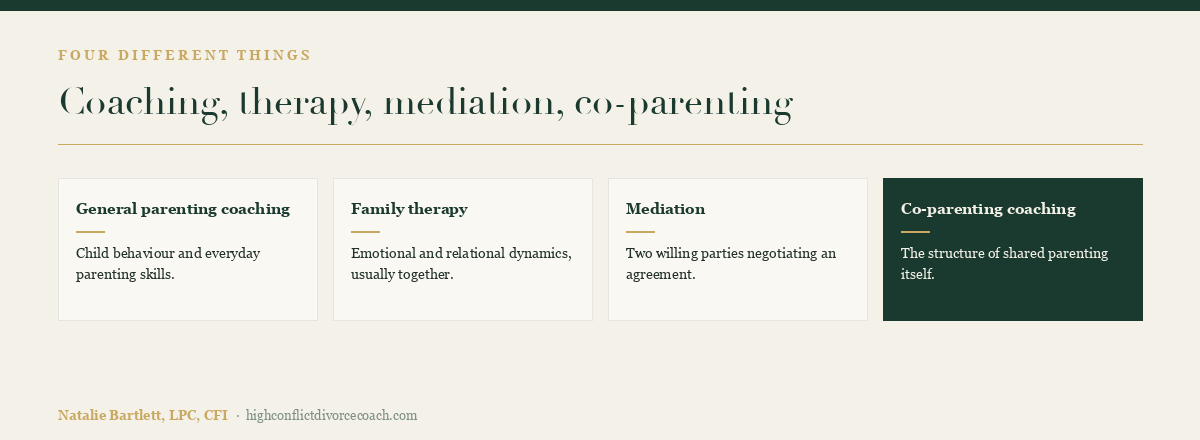
General parenting coaching helps with parenting skills and child behaviour, such as tantrums, routines and discipline. Useful, but not built for the problem of coordinating with a difficult co-parent.
Family therapy addresses emotional and relational dynamics, often with both parents or the whole family in the room together. It is not designed for a situation where one parent is not a willing participant.
Mediation helps two willing parties negotiate an agreement. It requires both people to be genuinely open to compromise, which is not always the reality in a high conflict separation.
Co-parenting coaching works on the practical structure of shared parenting itself. Schedules, handoffs, communication protocols, and how to respond to an uncooperative or escalating co-parent, whether or not the other side engages.
A co-parenting coach also does not give legal advice, draft custody agreements, or represent anyone in court. That is an attorney's role, and any support work should stay clearly inside its own lane.
Signs a co-parenting coach might help
A few patterns tend to show up when this kind of support genuinely fits.
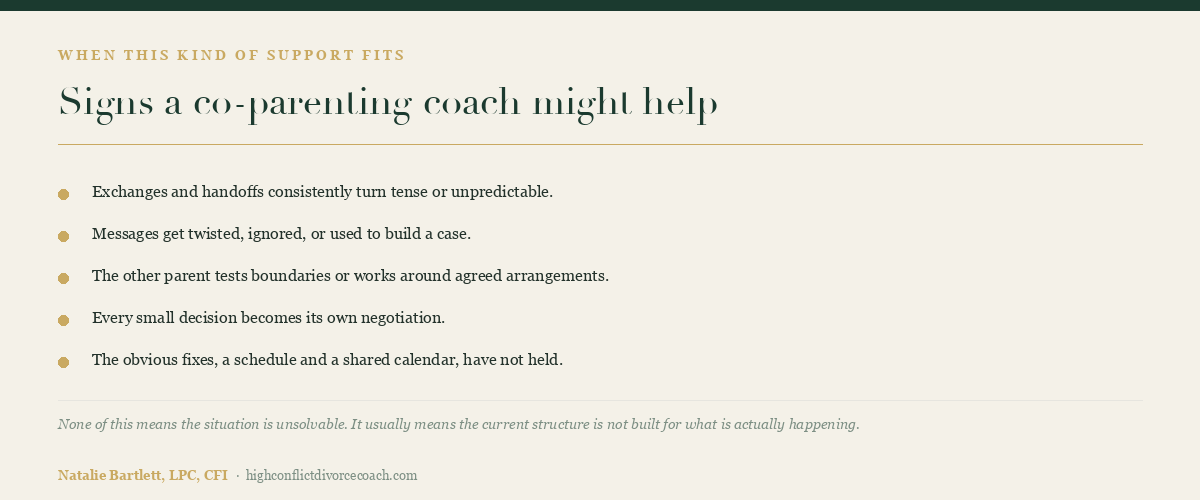
Exchanges and handoffs consistently turn tense or unpredictable. Messages get twisted, ignored, or used to build a case rather than to communicate. The other parent seems to be testing boundaries or working around agreed arrangements. Or every small decision becomes its own negotiation, whether it is a schedule change, a school event or a doctor's appointment.
None of this means the situation is unsolvable. It usually means the current approach to communication and structure is not built for what is actually happening.
It is also common to reach this point after trying the more obvious fixes first. A detailed parenting-time schedule. A shared calendar app. An agreement to communicate better.
Those tools genuinely help in a cooperative co-parenting relationship. In a higher conflict one, they tend to become just another surface for the same underlying pattern to play out on. That is usually the signal that the issue is not the tools themselves, but the framework they are operating inside.
What working with a coach looks like
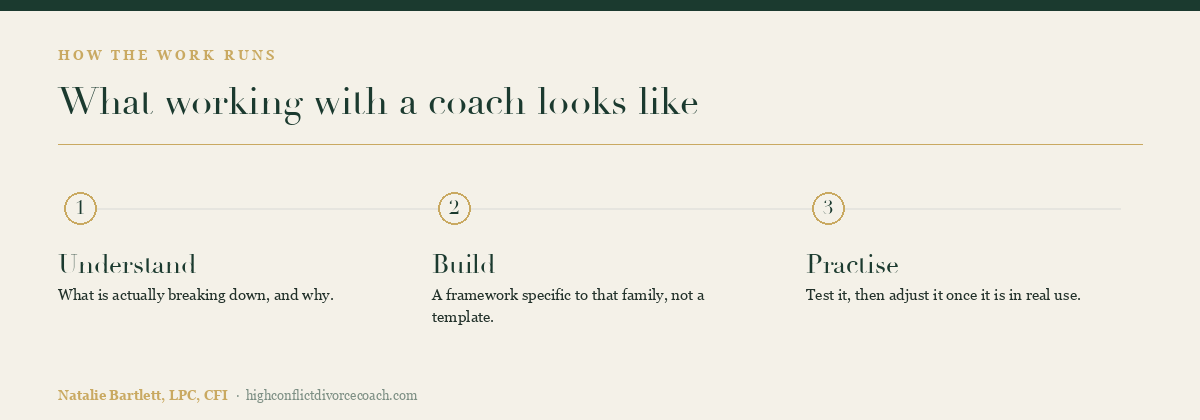
Most engagements start with understanding the specific pattern at play, and what is actually breaking down.
From there the work shifts to building a concrete framework. How handoffs will happen. What communication looks like day to day. How disagreements get handled without escalating. How the children are protected from the adult conflict in the meantime.
When there are children involved, part of the work is specifically about their experience. Not just solving the adults' logistics problem, but making sure the structure actually reduces what the children are exposed to.
This is also a different pace of work than a single consultation. Building a framework that holds up under real pressure usually takes more than one conversation. That pressure might be a missed handoff, a last-minute schedule change or a hostile message. It typically involves understanding each parent's situation individually first. Then developing something specific to that family rather than a generic template. Then practising and adjusting it once it is actually in use.
Where The Peace Table fits
is built specifically for this. It is a nine-session framework designed to function without requiring the other parent's cooperation.
It starts with each parent assessed individually. It moves into building a structure specific to that family's actual dynamics. It finishes with that framework introduced and practised in joint sessions, including dedicated attention to how the children are experiencing the conflict.
It accepts both privately engaged and court-referred clients, and documentation of completion is available where that is relevant to a court process.
For a related pattern, goes deeper into that specific dynamic.
Frequently asked questions
-
No. A mediator helps two willing parties negotiate an agreement, and that depends on both people being open to compromise. A co-parenting coach builds a working structure for ongoing communication and logistics. That is especially useful when one parent is not a fully willing participant in the process.
-
Often yes. Coaching can build a framework for how you communicate and respond even without the other parent's cooperation, which is much of the value. A fully joint framework such as The Peace Table does require both parents to consent to take part, so the two are worth separating when you plan.
-
No. A coach does not give legal advice, draft custody agreements, or represent anyone in court. That is an attorney's role. Coaching works alongside legal representation rather than instead of it, and the two are most useful when each stays clearly inside its own lane.
-
General parenting coaching typically addresses child behaviour and everyday parenting skills, such as routines and discipline. Co-parenting coaching is specifically about the logistics and communication of raising children across two households, especially where the dynamic between the parents is high conflict.
-
Therapy tends to address emotional and relational dynamics, often with willing participants in the room together. Co-parenting coaching is more structural. It focuses on building a communication and logistics framework that works regardless of whether the other parent is fully cooperative.
About the author
Natalie Bartlett, LPC, CFI is a Licensed Professional Counselor (#3250) and court-appointed Child and Family Investigator based in the Denver metro area, serving courts across Colorado. Over twenty-six years she has served as a CFI, testified as an expert witness, worked as a mediator, supervised parenting time, and coached clients through high conflict divorce and custody matters.
Disclaimer The information provided in this article is for general educational and informational purposes only. It does not constitute, and should not be relied upon as, legal advice, therapeutic or mental health advice, medical advice, or professional counseling of any kind.
High Conflict Divorce Coach provides strategic divorce and co-parenting coaching. It does not provide legal services, psychotherapy, counseling, diagnosis, or treatment. While Natalie Bartlett holds a license as a Licensed Professional Counselor, she does not provide therapy, counseling, or clinical services through High Conflict Divorce Coach, and no therapeutic or counseling relationship is created by reading this content or by engaging High Conflict Divorce Coach for coaching services.
Reading this article does not create a coaching, counseling, or professional relationship of any kind. Every situation is different. Nothing here should be acted upon without consulting a qualified attorney, licensed mental health professional, or other appropriate professional regarding your specific circumstances.
If you are experiencing a mental health crisis or emergency, contact a licensed professional or emergency services immediately. If you are in immediate danger, call 911.