
The Stages of Mourning a Divorce (and Why They Don’t Move in a Straight Line)
The stages of mourning a divorce are not really stages at all. Divorce grief does not always look like grief. It can show up as anger about logistics, numbness during a handoff, or relief followed immediately by guilt for feeling relieved.
It is a real loss. The loss of a shared future, a daily structure, and sometimes a whole identity built around the marriage. It deserves to be understood on its own terms, rather than squeezed into a five-step checklist that says you should be finished by a certain point.
This looks at the emotional territory people commonly move through after a divorce, why it rarely proceeds in order, and what tends to help.
Why divorce grief is its own kind of loss
Grief after a death has a clear, single loss at its centre. Divorce grief is messier.
The person is usually still alive. Sometimes they are still part of daily life through co-parenting. And the loss itself is layered. The relationship, the future that was planned, the routines, sometimes friendships or in-laws. Often a version of yourself that existed inside that marriage.
In a high conflict divorce there is an added layer. The grief has to coexist with ongoing stress, conflict or legal process. That rarely leaves room to simply sit with the loss the way grief usually asks for.
The emotional territory, not a fixed sequence
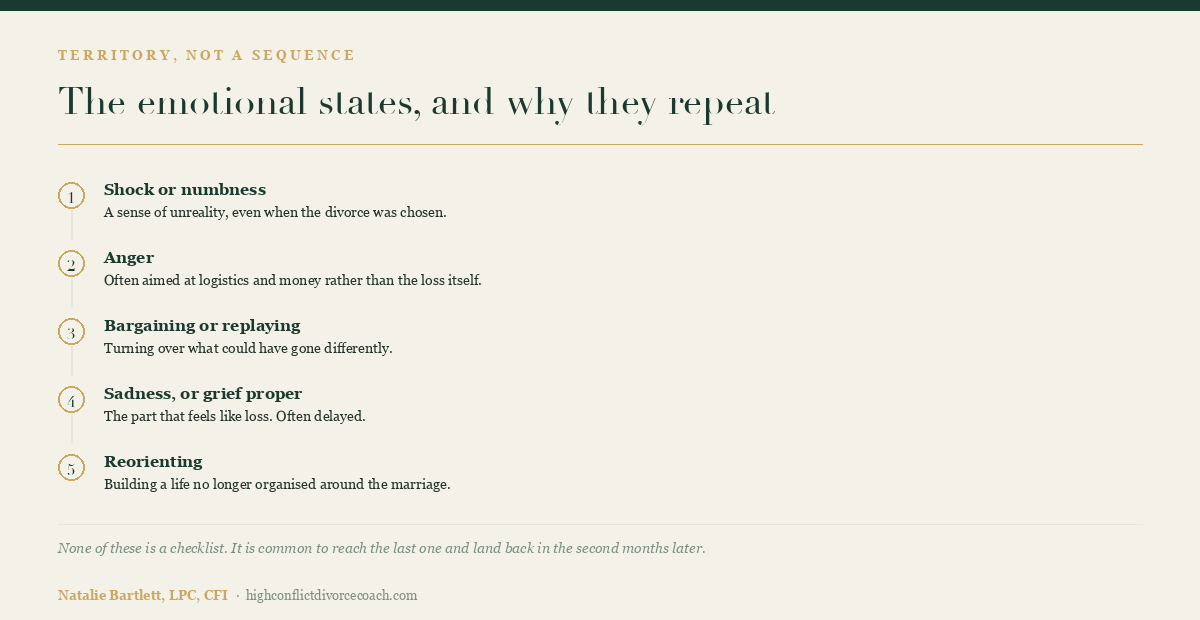
People commonly move through some version of the following. The stages of mourning a divorce are better understood as territory than as a sequence. They rarely arrive in a clean order, and the same one often returns more than once.
Shock or numbness. A sense of unreality, even when the divorce was not sudden, and even when it was actively chosen.
Anger. Often redirected at logistics, money or co-parenting friction rather than felt directly about the loss itself.
Bargaining or replaying. Turning over what could have gone differently, sometimes long after there is anything left to change.
Sadness, or grief proper. The part that actually feels like loss. Many people delay it, because the practical demands of a divorce do not pause for it.
Reorienting. Not moving on in the sense of forgetting, but building a life and an identity that is no longer organised around the marriage or the conflict.
None of these is a checklist to complete in order. It is common to feel some version of reorienting and then land back in anger months later. Anniversaries, co-parenting conflict, or a new development in the other person's life will all do it.
What makes it harder in a high conflict divorce
Ordinary grief usually eases with distance and time to process.
High conflict divorce grief often gets complicated, because the source of the loss has not fully receded. Continued contact through co-parenting, unresolved conflict or a slow legal process can keep reactivating grief that would otherwise have space to settle.
This is not a sign that something is wrong with how someone is grieving. It is a genuinely harder version of an already hard process, and it usually calls for more structure and support rather than less.
There is also a quieter version of this. Grieving something that was already gone long before the divorce itself.
In a high conflict marriage, the version of the relationship worth grieving sometimes ended years before the paperwork did. That can make the divorce feel less like the loss and more like a delayed acknowledgement of one. It does not make the grief smaller. It often makes it more disorienting, because the timeline does not match what people expect grief to look like from the outside.
What tends to help
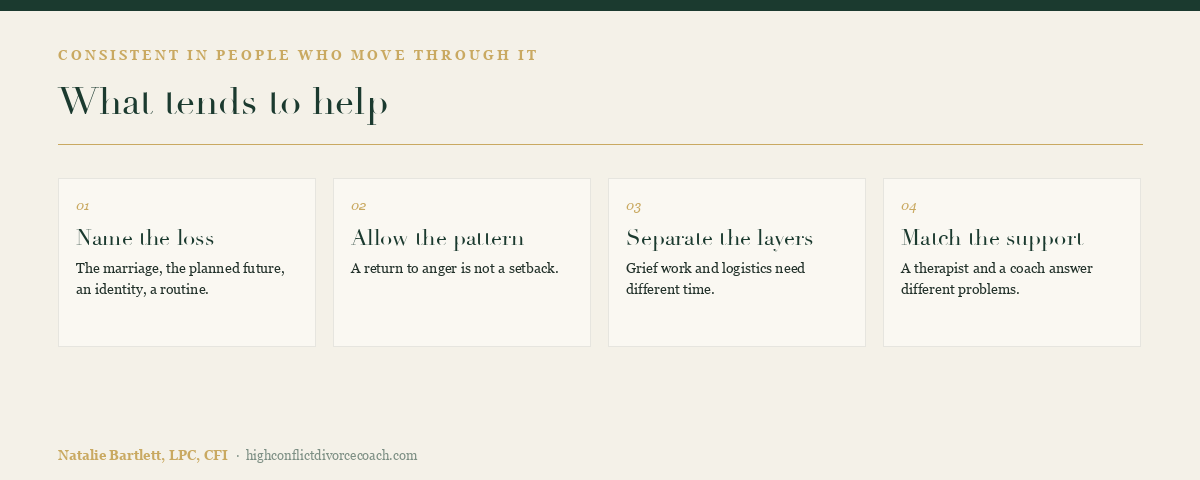
A few things show up consistently in people who move through this well, even slowly.
Name what is actually being grieved. The marriage, the planned future, an identity, a routine. Treating it as one vague loss makes it harder to move through.
Allow the non-linear pattern. A return to anger or sadness is not a setback. Expecting a straight line is what turns a normal pattern into a sense of failure.
Separate the grief from the logistics. The emotional work and the ongoing practicalities of co-parenting need different time and attention, so that one does not constantly interrupt the other.
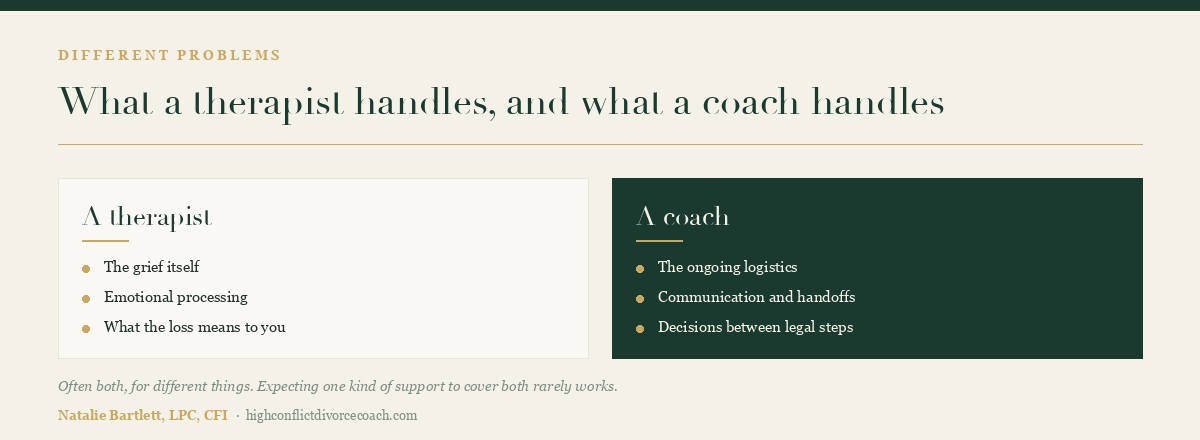
Match the support to the problem. Often that means a therapist for the grief itself and a coach for the ongoing practical relationship. Expecting one kind of support to cover both rarely works.
Where coaching fits
Coaching does not replace the emotional work of grieving a marriage. That is squarely a therapist's territory, and this article is not a substitute for that support.
What coaching helps with is the layer that often interferes with grieving in the first place. The ongoing logistics, communication and decision-making that a high conflict situation keeps demanding, while the emotional processing is still happening underneath it.
is built for exactly this. A single focused session on whatever is most pressing right now, without committing to a longer engagement before knowing whether it is the right fit.
If you are still working out whether what you are dealing with meets the threshold, it is worth reading what actually means first.
Frequently asked questions
-
Yes, and often both at once. Relief is a common response, particularly after a high conflict marriage, and it does not cancel out or invalidate grief that may surface later. Many people feel the relief first and the sadness months afterwards, which is disorienting but entirely ordinary.
-
There is no reliable general timeline, and it is not linear. Continued contact through co-parenting or ongoing conflict can extend and reactivate the process well beyond what a single clean loss would suggest. Anyone offering you a fixed number of months is guessing.
-
Yes, particularly if contact or conflict has continued. Grief tends to resurface around anniversaries, milestones, or new developments in the other person's life, rather than following a strict endpoint. That resurfacing is not a sign of failure, and it does not mean you are back where you started.
-
Often both, for different things. A therapist supports the emotional grief work directly. A coach supports the ongoing practical logistics and communication that can otherwise keep interrupting that process. They answer different problems and work well alongside each other.
-
This is common in high conflict divorce specifically, where ongoing contact or conflict can reactivate grief that would otherwise settle with distance and time. Each new dispute can return you to a feeling you thought was behind you, which is the pattern rather than a personal failing.
About the author
Natalie Bartlett, LPC, CFI is a Licensed Professional Counselor (#3250) and court-appointed Child and Family Investigator based in the Denver metro area, serving courts across Colorado. Over twenty-six years she has served as a CFI, testified as an expert witness, worked as a mediator, supervised parenting time, and coached clients through high conflict divorce and custody matters.
Disclaimer The information provided in this article is for general educational and informational purposes only. It does not constitute, and should not be relied upon as, legal advice, therapeutic or mental health advice, medical advice, or professional counseling of any kind.
High Conflict Divorce Coach provides strategic divorce and co-parenting coaching. It does not provide legal services, psychotherapy, counseling, diagnosis, or treatment. While Natalie Bartlett holds a license as a Licensed Professional Counselor, she does not provide therapy, counseling, or clinical services through High Conflict Divorce Coach, and no therapeutic or counseling relationship is created by reading this content or by engaging High Conflict Divorce Coach for coaching services.
Reading this article does not create a coaching, counseling, or professional relationship of any kind. Every situation is different. Nothing here should be acted upon without consulting a qualified attorney, licensed mental health professional, or other appropriate professional regarding your specific circumstances.
If you are experiencing a mental health crisis or emergency, contact a licensed professional or emergency services immediately.