
How to Prove Parental Alienation: Recognising It and Documenting It
A child's relationship with you starts deteriorating in ways that do not match your actual relationship with them. Sudden resistance to visits. Borrowed language that does not sound like a child's own words. Accusations that shift and grow over time.
You may be looking at parental alienation. Parents living through it are usually searching for the same two things: language for what is happening, and a way to record it that will hold up.
There is something important to understand at the outset. Parental alienation is not a legal claim you file and it is not a psychiatric diagnosis you receive. That surprises most parents. What it means in practice is that proving it is not a matter of getting a label attached. It is a matter of putting specific, dated evidence of behaviour in front of the right professional, in a form the court can already work with.
This covers what the pattern looks like, how it differs from ordinary reluctance, and how to prove parental alienation through documentation that a professional can actually use.
What is parental alienation?
Parental alienation describes a pattern where a child's relationship with one parent is undermined by the other parent's words, actions or behaviour. Not by anything the targeted parent actually did.
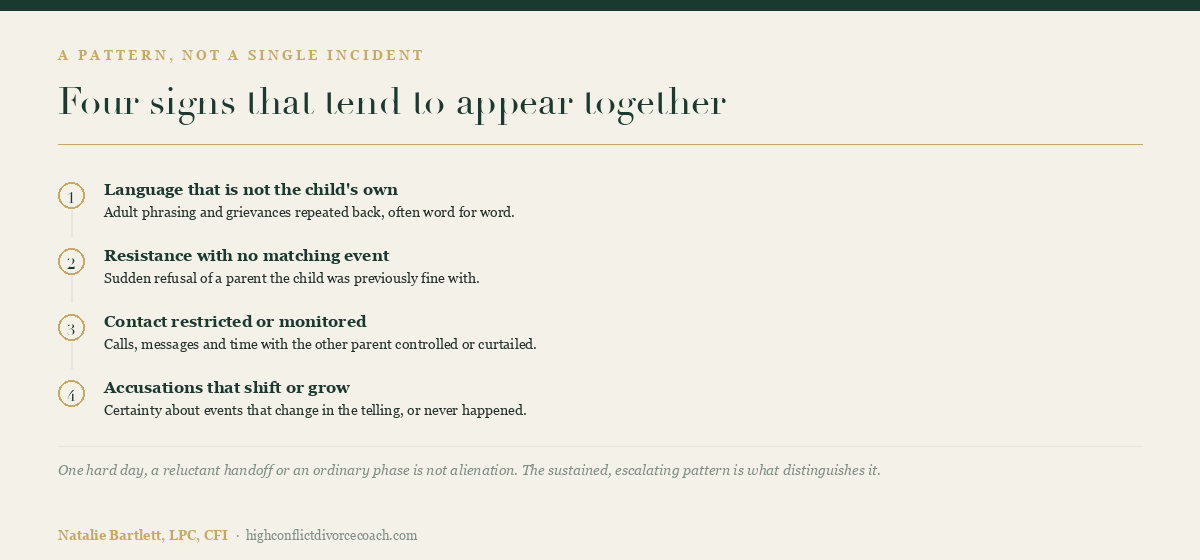
It shows up as a cluster of behaviours more than any single incident. A child parroting adult language and grievances that are not their own. Sudden, disproportionate resistance to a parent they previously had a normal relationship with. One parent restricting or monitoring communication and time with the other. A child expressing certainty about accusations that shift, grow, or do not match anything that actually happened.
The pattern matters more than any one moment. A single hard day, a reluctant handoff, or an ordinary developmental phase is not alienation on its own. It is the sustained, escalating pattern across many small moments that distinguishes it.
Is parental alienation a diagnosis?
No, and knowing that will save you a great deal of wasted effort.
When the fifth edition of the Diagnostic and Statistical Manual was being developed, a proposal was put forward to include parental alienation as a distinct disorder. The DSM-5 Task Force declined. Their reasoning was not that the problem is imaginary. It was that a mental disorder, by the manual's own definition, has to exist as an internal condition within one individual. Alienation is a description of a relationship between people, so it did not fit the category.
What clinicians can record is a related term. Child Affected by Parental Relationship Distress, coded Z62.898, sits in the DSM-5 chapter covering other conditions that may be a focus of clinical attention. The manual describes it as applying when the clinical focus is the negative effect on a child of parental relationship discord, including high conflict, distress or disparagement.
In their 2016 clinical review in the *Journal of the American Academy of Child and Adolescent Psychiatry*, Bernet, Wamboldt and Narrow set out how this category is applied. They describe children reacting to acrimonious divorce and to unfair disparagement of one parent by the other. Responses range from psychological symptoms and somatic complaints to internal loyalty conflicts, and in the most extreme presentations, parental alienation.
So a therapist can document what a child is experiencing under a recognised code. What no clinician can do is hand you a diagnosis of parental alienation, because no such diagnosis exists. Any professional who offers you one is telling you something the manual does not support.
What it is not
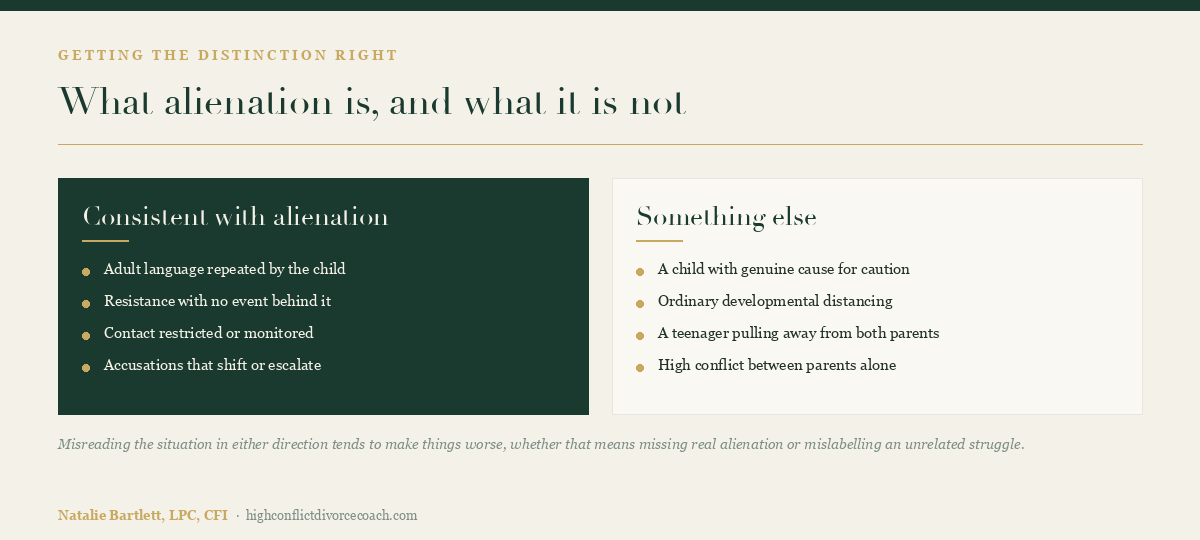
Not every strained parent and child relationship is alienation. Treating every difficulty as alienation does real harm, both to the co-parenting relationship and to the child.
A child can have legitimate reasons to be cautious around a parent, including that parent's own past behaviour. Ordinary developmental resistance is not the same pattern. A teenager pulling away from both parents is doing something else entirely. And high conflict between parents, on its own, is not automatically alienation. It is a separate and serious problem, but a different one.
This distinction is not a matter of opinion. It is the central finding of the most influential paper written on the subject. In 2001, psychologists Joan Kelly and Janet Johnston published "The Alienated Child: A Reformulation of Parental Alienation Syndrome" in *Family Court Review*. Their work shifted the focus away from blaming one parent and onto the child's actual situation. They identified a whole system of contributing factors, including intense marital conflict, a humiliating separation, the personalities and behaviour of both parents, protracted litigation, and mismanagement by the professionals involved.
Their conclusion is worth sitting with. Attributing a child's rejection of a parent primarily to the other parent is, in their assessment, overly simplistic and not supported by the empirical research.
That is not a reason to dismiss what you are seeing. It is a reason to document behaviour carefully and let a qualified professional assess it, rather than arriving at a conclusion first and collecting evidence to support it afterwards. Courts and evaluators are alert to the difference, and a parent who has clearly decided the answer in advance tends to be taken less seriously, not more.
This is also where outside perspective helps most. A parent inside a high conflict situation is rarely in a neutral position to judge their own read of it. Not because their concerns are invalid. It is genuinely hard to separate a pattern that matches alienation from what a painful stretch of parenting looks like, while living inside it.
How courts actually handle it
Because alienation is neither a diagnosis nor a standalone legal claim, it reaches a court through a different door. In Colorado, that door is the best interests statute.
When a court decides parenting time and decision-making, it works through the factors listed at C.R.S. § 14-10-124. One of those factors, at subsection (1.5)(a)(VI), is "the ability of the parties to encourage the sharing of love, affection, and contact between the child and the other party."
That single line is the mechanism. A parent does not ask a Colorado court to find that alienation occurred. They put evidence before the court that speaks to a factor the court is already required to weigh.
The same subsection carries a protection that matters enormously, and it is frequently left out of articles on this topic. The statute states that if the court determines a party is acting to protect the child from witnessing domestic violence, or from being a victim of child abuse or neglect or domestic violence, that party's protective actions shall not be considered with respect to this factor.
In other words, the law anticipates that a "friendly parent" argument can be turned against a parent who is genuinely protecting a child, and it closes that door. If you are the protective parent, that sentence is on your side.
Where a court wants an independent assessment, it may appoint a Child and Family Investigator under C.R.S. § 14-10-116.5, with appointments and conduct governed by Chief Justice Directive 04-08, most recently amended effective 7 August 2024. A CFI investigates and makes independent recommendations to the court on the best interests of the child. Under CJD 04-08 the presumptive maximum fee for a privately paid CFI's investigation and report is $3,250 per appointment, which cannot be exceeded without a written court order making specific findings of extraordinary circumstances.
That is the professional your documentation is ultimately written for.
How to prove parental alienation: what to document
Documentation is most useful when it is specific, dated and focused on behaviour rather than interpretation. Five practices tend to hold up.
Log incidents as they happen, not from memory weeks later. The date, what was said or done, and who was present.
Save communications directly. Texts, emails, co-parenting app messages. Not paraphrased from memory.
Note the child's own words where possible, particularly language that sounds adult or rehearsed rather than something a child would naturally say.
Track patterns, not just incidents. Missed exchanges, cancelled time, and changes in the child's language or behaviour across weeks and months.
Avoid interpreting in the moment. Record what was observed, not a conclusion about why. "Child refused to get in the car and repeated a phrase about custody arrangements" holds up. "The other parent alienated our child today" does not.
That last point connects directly to Kelly and Johnston's finding. A record of observed behaviour lets a professional reach their own conclusion. A record of your conclusions invites them to discount the whole document.
None of this is about building a legal case yourself. It is about creating an accurate, contemporaneous record that a qualified professional can work with, whether that is a therapist, a Child and Family Investigator or an attorney.
A practical habit helps here. Keep the log in one consistent place, whether a dedicated notebook, document or app, rather than scattered across texts to friends and half-remembered notes. Review it periodically. Not to build a case in your own head, but to notice whether the pattern is escalating, holding steady or easing. That trajectory is usually what a professional wants to understand first.
It is also worth documenting the ordinary, positive moments alongside the difficult ones. A good visit. A warm exchange. A moment the child sought you out. A record that captures only conflict paints an incomplete picture, both for your own clarity and for anyone who eventually reviews it. The goal is an accurate record of the relationship as it actually is, not a curated case for one side.
Why the pattern is hard to see from the inside
Parents living through this often doubt themselves. They wonder whether they are overreacting, misreading an ordinary disagreement, or somehow contributing to what is happening.
That self-doubt is common, and it is part of what makes the pattern so disorienting. The shifting, escalating nature of it makes any single moment easy to explain away, even while the overall trajectory is unmistakable across months. This is exactly why documentation matters. A pattern that is nearly invisible day to day becomes clear once it is written down and reviewed as a whole.
There is a related trap worth naming. Because the pattern is so disorienting, some parents respond by pulling back entirely. Reducing contact, avoiding conflict, waiting it out, hoping things settle.
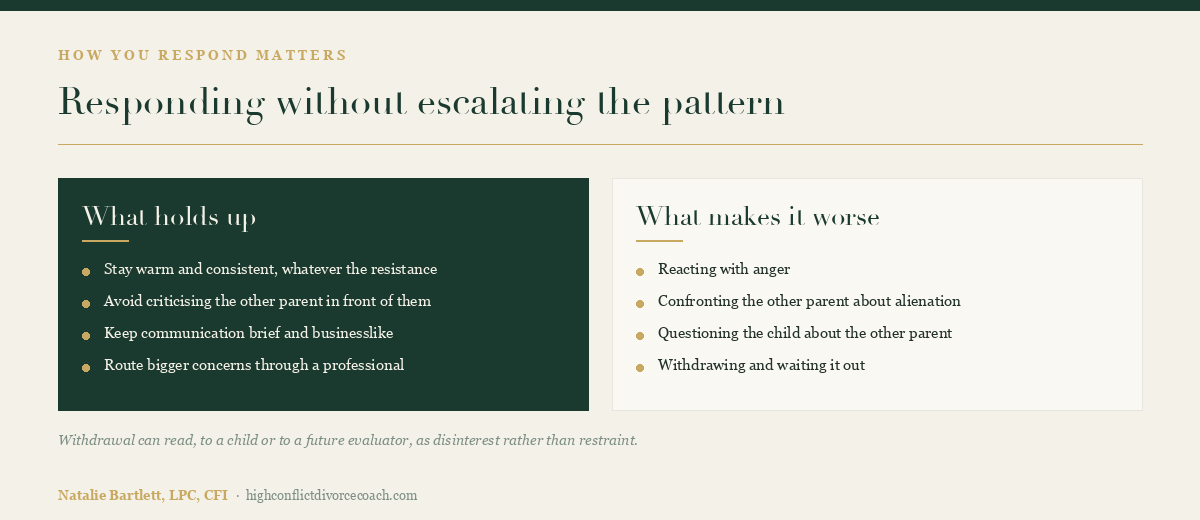
In some situations that caution is reasonable. But withdrawal can also read, to a child or to a future evaluator, as disinterest rather than restraint. That is why staying engaged and steady tends to matter as much as the documentation itself.
How this affects children
Whatever is driving the pattern, the child is the one living inside it. Caught between two parents, often absorbing language and conflict that is not theirs to carry.
Children in this situation frequently show signs that have nothing to do with taking sides. Anxiety around transitions. Confusion about their own feelings toward a parent. A sense of loyalty pressure they cannot fully articulate. These are the same presentations Bernet and colleagues describe under Child Affected by Parental Relationship Distress, and they are recognised precisely because they are common.
None of this is a reason to treat the child as evidence in an adult dispute. It is a reason to keep their experience at the centre of how you respond, not just the documentation.
Responding without escalating further
How a targeted parent responds matters almost as much as what is happening in the first place.
Reacting with anger, confronting the other parent directly about alienation, or pulling the child into the adult conflict with pointed questions all tend to make things worse. It can reinforce exactly the narrative being built, and it puts the child in a harder position.
A steadier approach holds up better. Stay warm and consistent with the child regardless of their resistance. Avoid criticising the other parent in front of them. Keep communication with the other parent brief and businesslike. Route bigger concerns through a professional rather than litigating them with the other parent or the child.
This is not about staying passive. It is about responding in a way that does not hand the pattern more material to work with. It is also worth remembering that Kelly and Johnston listed professional mismanagement and protracted litigation among the factors that consolidate alienation. How the adults around a child conduct themselves, including in court, is part of the picture rather than separate from it.
Where professional support fits
A parent navigating this needs more than documentation. They need a structure for how to respond, how to communicate without escalating, and how to protect the relationship with the child in the meantime.
The Peace Table is built for high conflict co-parenting dynamics like this one. Individual assessment first, then a communication and logistics framework built around the specific pattern at play, with dedicated attention to how the child is experiencing the conflict. It does not require the other parent's cooperation to function, and documentation of participation is available for court-referred engagements.
This work sits alongside a Child and Family Investigator or attorney where the situation calls for one, rather than instead of them. A coach does not diagnose, does not determine custody outcomes, and does not represent anyone in court. What it can do is help you respond clearly and consistently while the larger picture is addressed through the right channels.
For closely related patterns, co-parenting with a narcissist and the stages of divorcing a narcissist go deeper into the broader dynamic this often appears alongside.
Frequently asked questions
-
No. The DSM-5 Task Force declined to include it, because a mental disorder must exist as an internal condition within one individual, and alienation describes a relationship between people. Clinicians can instead record Child Affected by Parental Relationship Distress, code Z62.898.
-
Ordinary distress tends to be proportional and tied to something identifiable, such as a recent change or a hard exchange. It usually eases with consistency and time. Alienation tends to involve disproportionate, escalating resistance and language that does not sound like the child's own words.
-
You do not prove it as a claim in its own right. In Colorado you present evidence relevant to a statutory best interests factor, C.R.S. § 14-10-124(1.5)(a)(VI), which asks about each party's ability to encourage the child's relationship with the other party. Your attorney decides how the record is used.
-
Start with what is happening now, going forward. Dated incident logs, saved rather than paraphrased communications, and any notable changes in the child's language or behaviour. Do not wait for an incident big enough to feel worth recording, because the pattern is what matters rather than any single moment.
-
Yes. Sorting out whether a pattern is genuinely alienation, an unrelated strain, or something else is often part of the early work rather than a prerequisite for it. It is not something a parent needs to have figured out on their own before asking for help with it.
-
No. Documentation is something a parent does on an ongoing basis, and it is useful to you regardless of any court process. Whether and how it is used in a legal context is a conversation for a licensed attorney familiar with your case. It is not a decision to make alone.
Is parental alienation a recognised diagnosis?
No. The DSM-5 Task Force declined to include it, because a mental disorder must exist as an internal condition within one individual, and alienation describes a relationship between people. Clinicians can instead record Child Affected by Parental Relationship Distress, code Z62.898.
How is parental alienation different from a child being upset about the divorce?
Ordinary distress tends to be proportional and tied to something identifiable, such as a recent change or a hard exchange. It usually eases with consistency and time. Alienation tends to involve disproportionate, escalating resistance and language that does not sound like the child's own words.
How do you prove parental alienation in court?
You do not prove it as a claim in its own right. In Colorado you present evidence relevant to a statutory best interests factor, C.R.S. § 14-10-124(1.5)(a)(VI), which asks about each party's ability to encourage the child's relationship with the other party. Your attorney decides how the record is used.
What should I start documenting first?
Start with what is happening now, going forward. Dated incident logs, saved rather than paraphrased communications, and any notable changes in the child's language or behaviour. Do not wait for an incident big enough to feel worth recording, because the pattern is what matters rather than any single moment.
Can a coach help if I am not sure whether this is really happening?
Yes. Sorting out whether a pattern is genuinely alienation, an unrelated strain, or something else is often part of the early work rather than a prerequisite for it. It is not something a parent needs to have figured out on their own before asking for help with it.
Does documenting this replace talking to an attorney?
No. Documentation is something a parent does on an ongoing basis, and it is useful to you regardless of any court process. Whether and how it is used in a legal context is a conversation for a licensed attorney familiar with your case. It is not a decision to make alone.
Sources
Kelly, J. B., and Johnston, J. R. "The Alienated Child: A Reformulation of Parental Alienation Syndrome." *Family Court Review*, vol. 39, no. 3, 2001, pp. 249 to 266.
Bernet, W., Wamboldt, M. Z., and Narrow, W. E. "Child Affected by Parental Relationship Distress." *Journal of the American Academy of Child and Adolescent Psychiatry*, vol. 55, no. 7, July 2016, pp. 571 to 579.
American Psychiatric Association. *Diagnostic and Statistical Manual of Mental Disorders*, Fifth Edition, Text Revision. Child Affected by Parental Relationship Distress, Z62.898.
Colorado Revised Statutes § 14-10-124, Best interests of the child.
Colorado Revised Statutes § 14-10-116.5, Child and Family Investigators.
Colorado Supreme Court, Chief Justice Directive 04-08, Concerning Child and Family Investigators, amended effective 7 August 2024.
About the author
Natalie Bartlett, LPC, CFI is a Licensed Professional Counselor (#3250) and court-appointed Child and Family Investigator based in the Denver metro area, serving courts across Colorado. Over twenty-six years she has served as a CFI, testified as an expert witness, worked as a mediator, supervised parenting time, and coached clients through high conflict divorce and custody matters. More about Natalie
Disclaimer The information provided in this article is for general educational and informational purposes only. It does not constitute, and should not be relied upon as, legal advice, therapeutic or mental health advice, medical advice, or professional counseling of any kind.
High Conflict Divorce Coach provides strategic divorce and co-parenting coaching. It does not provide legal services, psychotherapy, counseling, diagnosis, or treatment. While Natalie Bartlett holds a license as a Licensed Professional Counselor, she does not provide therapy, counseling, or clinical services through High Conflict Divorce Coach, and no therapeutic or counseling relationship is created by reading this content or by engaging High Conflict Divorce Coach for coaching services.
Statutory references are to Colorado law as of the date of publication and may change. Court procedure varies by jurisdiction and by judicial district. Reading this article does not create a coaching, counseling, or professional relationship of any kind. Every situation is different. Nothing here should be acted upon without consulting a qualified attorney, licensed mental health professional, or other appropriate professional regarding your specific circumstances.
If you are experiencing a mental health crisis or emergency, contact a licensed professional or emergency services immediately.