
How to Start Over After a High-Conflict Divorce
Most advice on how to start over after divorce assumes the relationship is over. Both people move on, separately, and recovery is a matter of time.
In a high-conflict divorce, that is rarely the full picture. The conflict often does not end cleanly at the decree. Co-parenting continues. Old patterns resurface around handoffs and decisions. The sense of finally moving forward keeps getting interrupted. Starting over here is not about forgetting what happened. It is about building a life that is no longer organised around the conflict, even while some version of it carries on in the background.
This covers what actually tends to help, what commonly gets in the way, and how to know whether you are making real progress when it does not feel linear.
Why this is different from an ordinary breakup
Most divorce recovery advice is built for a clean ending. In a high-conflict divorce, especially one involving children, there is usually an ongoing structure: co-parenting logistics, shared decisions, the occasional flare-up. Moving on has to happen alongside continued contact, not after it stops.
That is a harder and slower kind of recovery. It is worth naming clearly, rather than measuring yourself against advice written for a situation you are not in.
How to start over after divorce: what actually helps
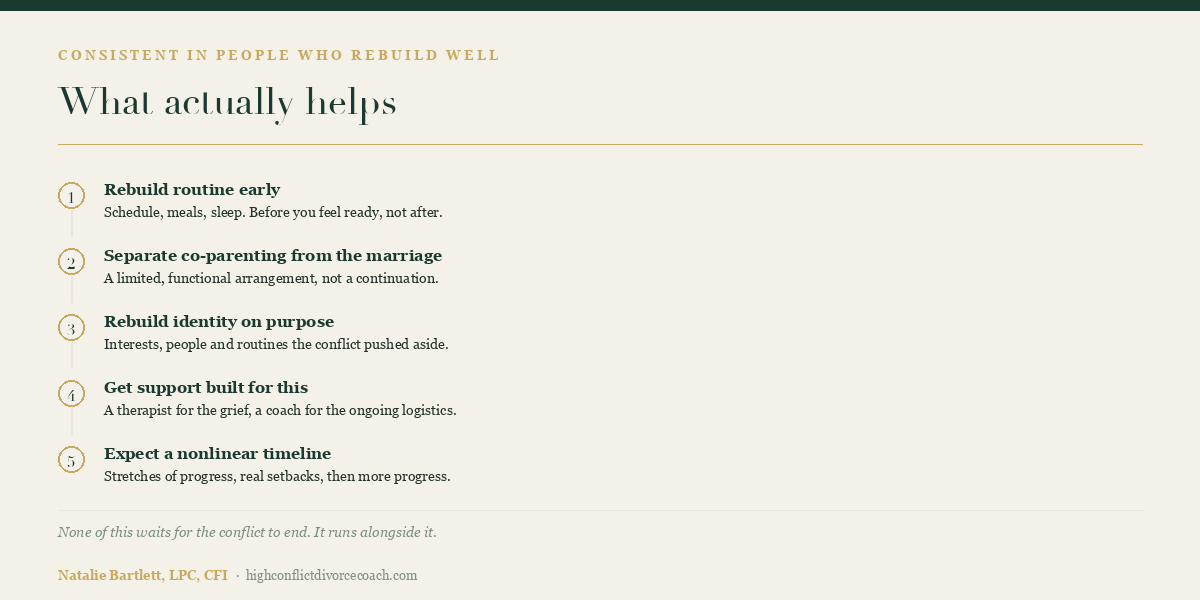
A few patterns show up consistently in people who rebuild well after a difficult divorce.
Rebuild routine early, even in small ways. A regular schedule, meals, sleep. Do this before you feel ready, rather than waiting for readiness to arrive first.
Separate the co-parenting relationship from the marriage. Treat ongoing contact as a functional, limited-purpose arrangement rather than a continuation of the relationship. It reduces how much each exchange reopens.
Rebuild identity outside the marriage on purpose. Reconnect with interests, people and routines that got sidelined during the conflict. This does not happen on its own.
Get support that is built for this. General breakup advice is not enough. A therapist for the emotional processing, and often a coach for the practical, ongoing logistics of co-parenting or continued contact.
Expect a nonlinear timeline. Progress tends to come in stretches, with real setbacks around anniversaries, handoffs and new flare-ups. It is not a steady upward line.
If the grief itself is the part that feels stuck, covers why those states repeat rather than progress, and what tends to help with each.
What commonly gets in the way
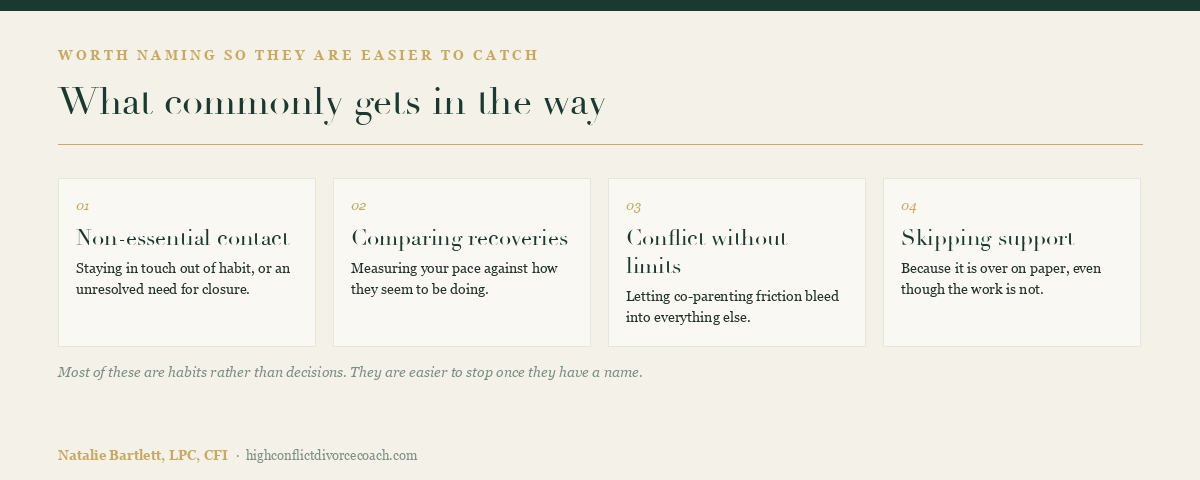
A few patterns reliably slow this down. They are worth naming so they are easier to catch.
Staying in frequent, non-essential contact with the other person, out of habit or an unresolved need for closure. Measuring your own recovery against how the other person seems to be doing. Letting co-parenting conflict bleed into every other part of life, rather than containing it to what is actually necessary. And skipping support because the divorce is "already over" on paper, even though the emotional and logistical work clearly is not.
Social comparison deserves a specific mention, because it shows up more than people expect. Seeing an ex appear to move on quickly, or hearing through mutual contacts that they seem fine, can feel like evidence that something is wrong with your own slower pace. It usually is not. People process high-conflict endings differently, and what looks like ease from the outside is rarely the whole picture.
Rebuilding with kids in the picture
When children are involved, starting over is not only a personal process. It is happening alongside theirs.
Children take their emotional cues from how steady their parents seem, more than from what is explicitly said. That does not mean hiding every difficulty. It does mean the pace of rebuilding often needs to account for their adjustment too, not just your own. Small, consistent routines help: a stable schedule, predictable handoffs, a calm tone even on hard days. They tend to settle children even while the adults are still finding their own footing.
Where the other parent makes that hard, goes into the communication and documentation habits that work without the other parent's agreement.
How to tell if you are actually making progress
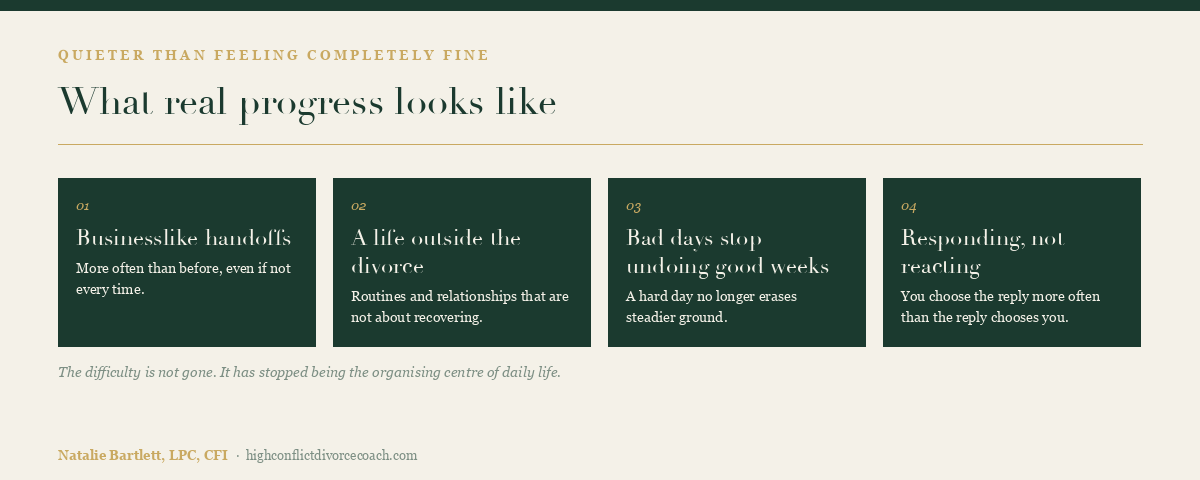
Progress after a high-conflict divorce rarely looks like feeling completely fine. The realistic markers are quieter than that.
Handoffs and co-parenting contact feel businesslike more often than they used to, even if not every time. You are building routines and relationships that exist independently of the divorce, not just recovering from it. A hard day no longer undoes weeks of steadier ground the way it once did. And you are responding to conflict more often than reacting to it.
None of these mean the difficulty is gone. They mean the difficulty has stopped being the organising centre of daily life.
Where coaching fits at this stage
Rebuilding after a high-conflict divorce usually means doing two things at once: the personal work of moving forward, and the practical, ongoing reality of contact with someone the conflict has not fully resolved with.
is built for exactly this stage. It is a structured period of support for building the communication habits and decision-making clarity that make ongoing contact more manageable, without pretending the relationship is starting fresh. covers what that support looks like in practice, and when it is and is not the right fit.
Frequently asked questions
-
By separating the two jobs. The co-parenting relationship becomes a limited, businesslike arrangement with clear channels and defined logistics, and your own rebuilding happens alongside it rather than waiting for it to end. Most people find the contact gets easier once it has a structure, even when the other person has not changed at all.
-
There is no reliable general timeline. It depends heavily on the specific situation, and most of all on whether ongoing co-parenting or contact continues. Progress is usually uneven rather than steady, with real setbacks along the way, and measuring yourself against a fixed number of months tends to make it harder rather than easier.
-
Yes, especially when contact continues through co-parenting. It does not necessarily mean something is wrong with your recovery. More often it means the contact itself needs a clearer structure, with fewer open channels and less room for the old dynamic to run. That is a practical problem, and it usually has a practical fix.
-
Often both, because they address different things. Therapy tends to focus on the emotional processing: the grief, the anger, what the loss means to you. Coaching tends to focus on the practical, ongoing logistics of co-parenting or continued contact, and on how you respond when the conflict flares. Expecting one to cover both rarely works.
-
That is common, and it is not a sign of doing it wrong. Recovery from a high-conflict divorce tends to happen in uneven stretches, with real dips around anniversaries, handoffs or new conflict, rather than as a straight line forward. A setback after weeks of steadier ground is part of the pattern, not evidence that the ground was never real.
